


€ 18,00 € 2,99 verzendkosten Totaal € 20,99

Gesponsorde links
|
|
18,00 |
Naar shop
|

|
28,72 |
Naar shop
|

|
28,72 |
Naar shop
|
| VERGELIJK ALLE AANBIEDERS (3) | ||
 Beschrijving
Vergelijk aanbieders (3)
Gesponsorde links · Sommige shops betalen ons een vergoeding
€ 18,00 € 2,99 verzendkosten Totaal € 20,99
€ 28,72 Gratis verzending
€ 28,72 Gratis verzending
Winkels met andere maten
Beschrijving
(1)
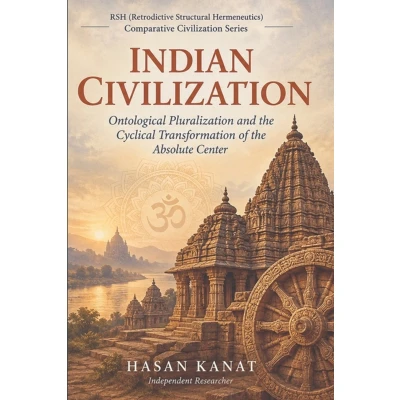
This study applies the five-stage model of Retrodictive Structural Hermeneutics (RSH 2.0)-Absolute Center ¿ Delegation of Authority ¿ Functional Representation ¿ Localization ¿ Structural Inflation-to Indian civilization. The model is used as a comparative analytical framework rather than as a necessarily linear historical sequence. In comparison with the bureaucratic pluralization examined in China, the normative/syncretic pluralization identified in Korea, and the network pluralization examined in Japan, the Indian case highlights a distinctive form of Ontological Pluralization. The study examines major configurations of Indian religious thought from the Vedic and Upani¿adic traditions through the Pur¿¿ic and Epic traditions, Bhakti traditions, and the traditions of Buddhism and Jainism (Flood, 1996; Olivelle, 1998; Jamison & Brereton, 2014).Particular attention is given to the tradition of the thirty-three devas, especially the dialogue in the B¿had¿räyaka Upani¿ad (3.9.1-2), where numerical plurality is progressively reduced to thirty-three and ultimately to one. The thirty-three are identified as the eight Vasus, eleven Rudras, twelve ¿dityas, Indra, and Praj¿pati. A closely related formulation occurs in the ¿atapatha Br¿hmäa (11.6.3.5-10). These passages provide a textual basis for examining the relationship between plurality, functional representation, and cosmological centralization.The study argues that Indian religious history is better understood not as a linear developmental sequence, but as a field of recurrent structural transformations in which conceptions of the Absolute, divine representation, and cosmological plurality undergo processes of ontological compression and expansion. The Indian case consequently provides a test of whether RSH can account for pluralization without presupposing a universal evolutionary trajectory.Keywords: Indian religion; Hinduism; Brahman; ¿tman; ¿ta; Varu¿a; Praj¿pati; Trim¿rti; avat¿ra; bhakti; Veda; Upani¿ad; Pur¿¿a; Bhagavad G¿t¿; Buddhism; Jainism; thirty-three devas; 33 koti; Ontological Pluralization; Avataric Functional Representation; Ontological Compression; Ontological Expansion; Ontological Synthesis; Retrodictive Structural Hermeneutics (RSH 2.0).
 Prijshistorie
* Prijshistorie bevat geen data van Amazon, Amazon Marketplace.
Prijzen voor het laatst bijgewerkt op:
 Gerelateerde resultaten
 Productspecificaties


