
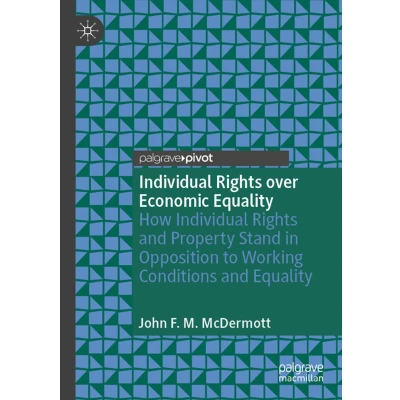
Individual Rights over Economic Equality: How and Property Stand in Opposition to Working Conditions Equality
Uitgelicht

|
42,99 |
Naar shop
|
| VERGELIJK ALLE AANBIEDERS (1) | ||
 Beschrijving
Bol
We are social animals, all embedded in (unequal) networks of social and economic relations, requiring very different explanatory frameworks from those given by individual rights theorizing. This book explores the ways in which the foundational ideology of individual rights belies the actualities of economic inequality. Since the mid-1960s, citizens' rights in the United States have improved across many areas, including race, gender, sexuality, physical disabilities, age, consumption of goods, voting, and more. During this time, there has also been a degradation in economic rights, such as economic inequality. Is there a reason for this contradiction? Is it possible for American citizens to experience rights and equality? At the center of natural rights theories lies the “inalienable” right to private property, and the concepts and practices of the accumulation of private property always defeat personal liberties. Modern political philosophers who espouse natural rights, including liberal John Rawls and conservative James M. Buchanan, share nearly identical premises and goals. The two sides do not often recognize that the free-standing individual at the center of mainstream theorizing in economics and politics simply does not exist. We are social animals, all embedded in (unequal) networks of social and economic relations, requiring very different explanatory frameworks from those given by individual rights theorizing. This book explores the ways in which the foundational ideology of individual rights belies the actualities of economic inequality. It argues that “individual rights” philosophy offers the main ideological basis for the astronomical accumulation of wealth that produces this inequality. Investigating the defects of rights theory, the book examines key concepts related to social progress and economic stability. The resulting text presents and analyzes the networks of contemporary corporate, business, and financial power that structurally and systemically limit the lives and choices of citizens in the United States.


Vergelijk aanbieders (1)

 Beschrijving
(1)
Beschrijving
(1)
We are social animals, all embedded in (unequal) networks of social and economic relations, requiring very different explanatory frameworks from those given by individual rights theorizing. This book explores the ways in which the foundational ideology of individual rights belies the actualities of economic inequality. Since the mid-1960s, citizens' rights in the United States have improved across many areas, including race, gender, sexuality, physical disabilities, age, consumption of goods, voting, and more. During this time, there has also been a degradation in economic rights, such as economic inequality. Is there a reason for this contradiction? Is it possible for American citizens to experience rights and equality? At the center of natural rights theories lies the “inalienable” right to private property, and the concepts and practices of the accumulation of private property always defeat personal liberties. Modern political philosophers who espouse natural rights, including liberal John Rawls and conservative James M. Buchanan, share nearly identical premises and goals. The two sides do not often recognize that the free-standing individual at the center of mainstream theorizing in economics and politics simply does not exist. We are social animals, all embedded in (unequal) networks of social and economic relations, requiring very different explanatory frameworks from those given by individual rights theorizing. This book explores the ways in which the foundational ideology of individual rights belies the actualities of economic inequality. It argues that “individual rights” philosophy offers the main ideological basis for the astronomical accumulation of wealth that produces this inequality. Investigating the defects of rights theory, the book examines key concepts related to social progress and economic stability. The resulting text presents and analyzes the networks of contemporary corporate, business, and financial power that structurally and systemically limit the lives and choices of citizens in the United States.
 Productspecificaties
| EAN |
|
|---|---|
| Maat |
|
 Prijshistorie
Prijzen voor het laatst bijgewerkt op:
 Gerelateerde resultaten


