


€ 115,00 Gratis verzending

Uitgelicht
|
|
115,00 |
Naar shop
|
| VERGELIJK ALLE AANBIEDERS (1) | ||
 Beschrijving
Vergelijk aanbieders (1)
€ 115,00 Gratis verzending
Winkels met andere maten
Beschrijving
(1)
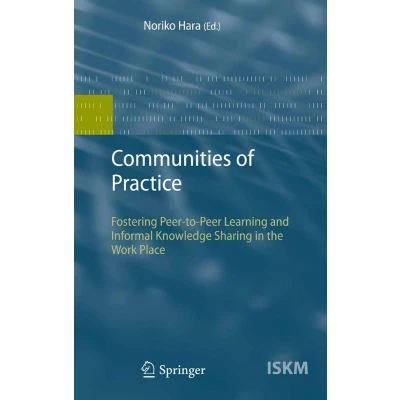
1.1 Introduction Each year corporations spend millions of dollars training and educating their - ployees. The book offers two themes: one is about Communities of Practice (CoPs) and learning, the other is about social informatics approaches. First, in order to facilitate designing effective learning environments both online and offline, this book calls attention to the importance of CoPs to facilitate informal learning as part of professional development. Communities of Practice are informal networks that support a group of practitioners to develop a shared meaning and engage in knowledge building among the members. The concept of CoPs is rooted in situated cognition (Brown, Collins, & Duguid, 1989; Lave, 1988) and the socio-cultural theory (Vygotsky, 1978). The book examines how people share and construct their knowledge by using case studies of public defender’s offices. Despite strong interests among practitioners and scholars, empirical studies of CoPs are sparse. Drawing on theories from situated cognition and social informatics, this book investigates what constitutes a community of practice and how members of the community create a shared meaning in workplaces with and without IT. 1.1 Introduction Each year corporations spend millions of dollars training and educating their - ployees. On average, these corporations spend approximately one thousand dollars 1 per employee each year. As businesses struggle to stay on the cutting-edge and to keep their employees educated and up-to-speed with professional trends as well as ever-changing information needs, it is easy to see why corporations are investing more time and money than ever in their efforts to support their employees’ prof- sional development. During the Industrial Age, companies strove to control natural resources. The more resources they controlled, the greater their competitive edge in the mark- place. Senge (1993) refers to this kind of organization as resource-based. In the Information Age, companies must create, disseminate, and effectively use kno- edge within their organization in order to maintain their market share. Senge - scribes this kind of organization as knowledge-based. Given that knowledge-based organizations willcontinuetobeadrivingforcebehindtheeconomy, itisimperative that corporations support the knowledge and information needs of their workers.
 Productspecificaties
| EAN |
|
|---|---|
| Maat |
|
 Prijshistorie
 Prijzen voor het laatst bijgewerkt op:
 Gerelateerde resultaten


