
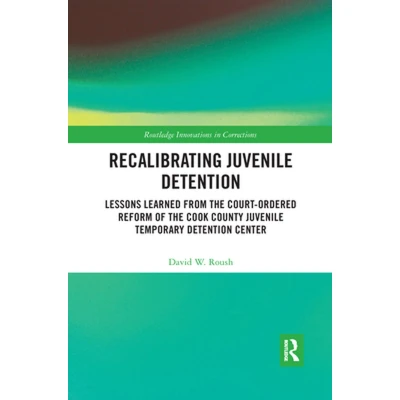
Innovations in Corrections Recalibrating Juvenile Detention
Uitgelicht

|
58,84 |
Naar shop
|

|
173,52 |
Naar shop
|
| VERGELIJK ALLE AANBIEDERS (2) | ||
 Beschrijving
Bol Partner
Recalibrating Juvenile Detention chronicles the lessons learned from the 2007 to 2015 landmark US District Court-ordered reform of the Cook County Juvenile Temporary Detention Center (JTDC) in Illinois, following years of litigation by the ACLU about egregious and unconstitutional conditions of confinement. Recalibrating Juvenile Detention chronicles the lessons learned from the 2007 to 2015 landmark US District Court-ordered reform of the Cook County Juvenile Temporary Detention Center (JTDC) in Illinois, following years of litigation by the ACLU about egregious and unconstitutional conditions of confinement. In addition to explaining the implications of the Court’s actions, the book includes an analysis of a major evaluation research report by the University of Chicago Crime Lab and explains for scholars, practitioners, administrators, policymakers, and advocates how and why this particular reform of conditions achieved successful outcomes when others failed. Maintaining that the Chicago Crime Lab findings are the "gold standard" evidence-based research (EBR) in pretrial detention, Roush holds that the observed "firsts" for juvenile detention may perhaps have the power to transform all custody practices. He shows that the findings validate a new model of institutional reform based on cognitive-behavioral programming (CBT), reveal statistically significant reductions in in-custody violence and recidivism, and demonstrate that at least one variation of short-term secure custody can influence positively certain life outcomes for Chicago’s highest-risk and most disadvantaged youth. With the Quarterly Journal of Economics imprimatur and endorsement by the President’s Council of Economic Advisors, the book is a reverse engineering of these once-in-a-lifetime events (recidivism reduction and EBR in pretrial detention) that explains the important and transformative implications for the future of juvenile justice practice. The book is essential reading for graduate students in juvenile justice, criminology, and corrections, as well as practitioners, judges, and policymakers.


 Beschrijving
(2)
Beschrijving
(2)
Recalibrating Juvenile Detention chronicles the lessons learned from the 2007 to 2015 landmark US District Court-ordered reform of the Cook County Juvenile Temporary Detention Center (JTDC) in Illinois, following years of litigation by the ACLU about egregious and unconstitutional conditions of confinement. Recalibrating Juvenile Detention chronicles the lessons learned from the 2007 to 2015 landmark US District Court-ordered reform of the Cook County Juvenile Temporary Detention Center (JTDC) in Illinois, following years of litigation by the ACLU about egregious and unconstitutional conditions of confinement. In addition to explaining the implications of the Court’s actions, the book includes an analysis of a major evaluation research report by the University of Chicago Crime Lab and explains for scholars, practitioners, administrators, policymakers, and advocates how and why this particular reform of conditions achieved successful outcomes when others failed. Maintaining that the Chicago Crime Lab findings are the "gold standard" evidence-based research (EBR) in pretrial detention, Roush holds that the observed "firsts" for juvenile detention may perhaps have the power to transform all custody practices. He shows that the findings validate a new model of institutional reform based on cognitive-behavioral programming (CBT), reveal statistically significant reductions in in-custody violence and recidivism, and demonstrate that at least one variation of short-term secure custody can influence positively certain life outcomes for Chicago’s highest-risk and most disadvantaged youth. With the Quarterly Journal of Economics imprimatur and endorsement by the President’s Council of Economic Advisors, the book is a reverse engineering of these once-in-a-lifetime events (recidivism reduction and EBR in pretrial detention) that explains the important and transformative implications for the future of juvenile justice practice. The book is essential reading for graduate students in juvenile justice, criminology, and corrections, as well as practitioners, judges, and policymakers.
BolRecalibrating Juvenile Detention chronicles the lessons learned from the 2007 to 2015 landmark US District Court-ordered reform of the Cook County Juvenile Temporary Detention Center (JTDC) in Illinois, following years of litigation by the ACLU about egregious and unconstitutional conditions of confinement. In addition to explaining the implications of the Court’s actions, the book includes an analysis of a major evaluation research report by the University of Chicago Crime Lab and explains for scholars, practitioners, administrators, policymakers, and advocates how and why this particular reform of conditions achieved successful outcomes when others failed. Maintaining that the Chicago Crime Lab findings are the "gold standard" evidence-based research (EBR) in pretrial detention, Roush holds that the observed "firsts" for juvenile detention may perhaps have the power to transform all custody practices. He shows that the findings validate a new model of institutional reform based on cognitive-behavioral programming (CBT), reveal statistically significant reductions in in-custody violence and recidivism, and demonstrate that at least one variation of short-term secure custody can influence positively certain life outcomes for Chicago’s highest-risk and most disadvantaged youth. With the Quarterly Journal of Economics imprimatur and endorsement by the President’s Council of Economic Advisors, the book is a reverse engineering of these once-in-a-lifetime events (recidivism reduction and EBR in pretrial detention) that explains the important and transformative implications for the future of juvenile justice practice. The book is essential reading for graduate students in juvenile justice, criminology, and corrections, as well as practitioners, judges, and policymakers.
 Productspecificaties
| EAN |
|
|---|---|
| Maat |
|
 Prijshistorie
Prijzen voor het laatst bijgewerkt op:
 Gerelateerde resultaten


