

€ 33,95 Gratis verzending

Uitgelicht
|
|
33,95 |
Naar shop
|

|
33,95 |
Naar shop
|

|
33,95 |
Naar shop
|
| VERGELIJK ALLE AANBIEDERS (3) | ||
 Beschrijving
Vergelijk aanbieders (3)
€ 33,95 Gratis verzending
€ 33,95 Gratis verzending
€ 33,95 Gratis verzending
Winkels met andere maten
Beschrijving
(1)
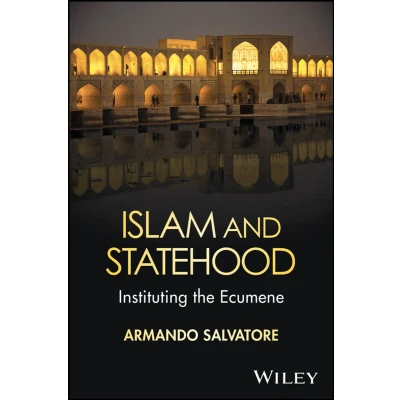
“This is what scholarship should be: courageous enough to reinvent itself, and wise enough to know why.” — KAMALUDEEN NASIR, Nanyang Technological University, Singapore “Long awaited and simply brilliant, this book marks the zenith of over three decades of research in the sociology of Islam and its ecumene, civility, and translocal connections. A must-read across the social sciences and humanities.” — HEBA RAOUF EZZAT, Ibn Haldun University, Istanbul “The book offers a searching challenge to Eurocentric frameworks in the study of political thought and state formation, illuminating dimensions of the Islamic tradition that have too often been obscured by those frameworks.” — USAAMA AL-AZAMI, Hamad Bin Khalifa University, Doha Islam and Statehood: Instituting the Ecumene offers a profound rethinking of how institutions and political authority emerged across the Islamic ecumene. Rather than interpreting Islamic statehood as a defective match for European models, Armando Salvatore presents it as the outcome of an original instituting process—rooted in narrative, habitus, and civility. He traces a rich intellectual and historical arc from Prophetic narration and Sufi embodiment to early modern forms of reflexive governance, revealing how the Islamic ecumene generated dynamic and adaptive frameworks of legitimacy and rule. Through close engagement with sources ranging from hadith and adab literature to Ibn Khaldun’s theory of ‘asabiyya, Salvatore reconstructs the Islamic ecumene as a field of continuous institutional creativity. He examines how formations such as waqf, tariqa, and adab–siyasa shaped relational and “circular” sovereignties that flourished well beyond Western political theology’s normative model of the body politic. In doing so, the author challenges longstanding assumptions about both the limits of “Islamic state” formation and the nature of political modernity. Explores the formation of Islamic institutions and statehood beyond eurocentric models of sovereignty Islam and Statehood: Instituting the Ecumene offers a groundbreaking reinterpretation of how socioreligious and political institutions took shape across the Islamic ecumene. Leaving behind eurocentric categories of sociopolitical theory in favor of an Italian brand of “Southern” thought, Armando Salvatore advances an alternative framework for understanding state formation in the Islamic ecumene—not as a belated imitation of European models, but as an original instituting process grounded in relational and adaptive modes of authority. Tracing a trajectory from Prophetic narration and Sufi habitus to early modern configurations of saintly power and reflexive governance, this second volume of the Sociology of Islam trilogy provides a conceptual map that connects embodied traditions of civility to self-renewing patterns of political legitimacy culminating in the institution of the Caliphate. Written with conceptual precision and historical depth, this volume reveals how the Islamic ecumene cultivated forms of “circular” sovereignty that evolved dynamically across time and geography. Islam and Statehood engages critically with eurocentric paradigms of Western political theology and sociology while illuminating the distinctive rationalities that shaped institutional innovation in the ecumene. Situating statehood as part of a wider institutional experiment in balancing divine mediation, habitus formation, and pragmatic governance, the book: Develops an original approach to statehood within the Islamic ecumene Introduces the concept of “instituting” as a dynamic and adaptive process distinct from European models of corporation and sovereignty Builds on and complements The Sociology of Islam in developing a broader theory of formation of the Islamic ecumene by reinterpreting Ibn Khaldun’s theory through the lens of “Southern” thought. Islam and Statehood: Instituting the Ecumene is ideal for advanced undergraduate and graduate courses in Islamic Studies, Religious Studies, Middle East Studies, and Comparative Politics. It is particularly well-suited for courses exploring state formation, political theology, and non-Western sociological theory.
 Prijshistorie
* Prijshistorie bevat geen data van Amazon, Amazon Marketplace.
Prijzen voor het laatst bijgewerkt op:
 Gerelateerde resultaten
 Productspecificaties


