
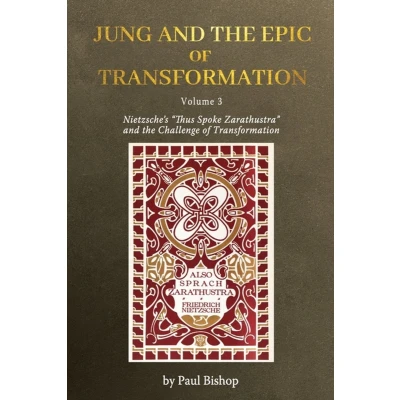
Jung and the Epic of Transformation Volume 3: Nietzsche’s “Thus Spoke Zarathustra Challenge
Uitgelicht

|
28,99 |
Naar shop
|

|
31,33 |
Naar shop
|

|
31,33 |
Naar shop
|
| VERGELIJK ALLE AANBIEDERS (3) | ||
 Beschrijving
Bol
According to Jung, Part Two of Goethe's Faust was a link in the Aurea Catena from philosophical alchemy and Gnosticism down to Nietzsche's Zarathustra: both works were "mostly unpopular, ambiguous, and dangerous," constituting a "voyage of discovery to the other pole of the world." Yet Jung believed that Nietzsche had not understood himself when he "fell into the mystery and into the unspeakable," singing its praises to "the crowd that had been forsaken by all the gods." In Nietzsche's "Thus Spoke Zarathustra" and the Challenge of Transformation, Paul Bishop examines the significance for Jung of the great thinker of modernity - and postmodernity. For if Zarathustra was Nietzsche's Faust, Jung saw his own No. 2 personality as corresponding to Zarathustra. After all, Nietzsche was, like Jung, the son of a clergyman - and as Jung frequently reminded those attending his legendary seminar on Zarathustra, "I know what that means"! This is the third volume in a series of books, examining key texts in German literature and thought that were, in Jung's own estimation or by scholarly consent, highly influential on his thinking. The project of Jung and the Epic of Transformation consists of four titles, sequentially arranged to explore great works from a Jungian perspective and in turn to highlight their importance for interpreting The Red Book. Table of Contents List of Abbreviations Abbreviations of titles of Nietzsche's works Editions of translations cited Commentaries on Nietzsche's "Zarathustra" (in alphabetical order of author) Jungian approaches to Nietzsche (in chronological order) Acknowledgements Preface Chapter 1 Zarathustra Highlights 1. Part One, Prologue 2. "Of the Three Transformations" 3. Übermensch 4. (a) "The Midnight-Song" (b) "The Sign" Chapter 2 Nietzsche's Zarathustra in Jung's Collected Works [A] Nietzsche's Zarathustra in Transformations and Symbols of the Libido (1911-12) Excursus: The Grail in Jung's Seminar on Nietzsche's Zarathustra Chapter 3 Nietzsche's Zarathustra in Jung's Collected Works [B] Nietzsche in Jung's Early Systematic and Typological Writings Excursus: Nietzsche and Zarathustra in Memories, Dreams, Reflections Chapter 4 Nietzsche's Zarathustra in Jung's Collected Works [C] Nietzsche and Zarathustra in Psychology and Alchemy (1944) Nietzsche and Zarathustra in Mysterium Coniunctionis (1955-1956) Conclusion (A) Conclusion (B) Bibliography


 Beschrijving
(1)
Beschrijving
(1)
According to Jung, Part Two of Goethe's Faust was a link in the Aurea Catena from philosophical alchemy and Gnosticism down to Nietzsche's Zarathustra: both works were "mostly unpopular, ambiguous, and dangerous," constituting a "voyage of discovery to the other pole of the world." Yet Jung believed that Nietzsche had not understood himself when he "fell into the mystery and into the unspeakable," singing its praises to "the crowd that had been forsaken by all the gods." In Nietzsche's "Thus Spoke Zarathustra" and the Challenge of Transformation, Paul Bishop examines the significance for Jung of the great thinker of modernity - and postmodernity. For if Zarathustra was Nietzsche's Faust, Jung saw his own No. 2 personality as corresponding to Zarathustra. After all, Nietzsche was, like Jung, the son of a clergyman - and as Jung frequently reminded those attending his legendary seminar on Zarathustra, "I know what that means"! This is the third volume in a series of books, examining key texts in German literature and thought that were, in Jung's own estimation or by scholarly consent, highly influential on his thinking. The project of Jung and the Epic of Transformation consists of four titles, sequentially arranged to explore great works from a Jungian perspective and in turn to highlight their importance for interpreting The Red Book. Table of Contents List of Abbreviations Abbreviations of titles of Nietzsche's works Editions of translations cited Commentaries on Nietzsche's "Zarathustra" (in alphabetical order of author) Jungian approaches to Nietzsche (in chronological order) Acknowledgements Preface Chapter 1 Zarathustra Highlights 1. Part One, Prologue 2. "Of the Three Transformations" 3. Übermensch 4. (a) "The Midnight-Song" (b) "The Sign" Chapter 2 Nietzsche's Zarathustra in Jung's Collected Works [A] Nietzsche's Zarathustra in Transformations and Symbols of the Libido (1911-12) Excursus: The Grail in Jung's Seminar on Nietzsche's Zarathustra Chapter 3 Nietzsche's Zarathustra in Jung's Collected Works [B] Nietzsche in Jung's Early Systematic and Typological Writings Excursus: Nietzsche and Zarathustra in Memories, Dreams, Reflections Chapter 4 Nietzsche's Zarathustra in Jung's Collected Works [C] Nietzsche and Zarathustra in Psychology and Alchemy (1944) Nietzsche and Zarathustra in Mysterium Coniunctionis (1955-1956) Conclusion (A) Conclusion (B) Bibliography
 Productspecificaties
 Prijshistorie
* Prijshistorie bevat geen data van Amazon, Amazon Marketplace.
Prijzen voor het laatst bijgewerkt op:
 Gerelateerde resultaten


