
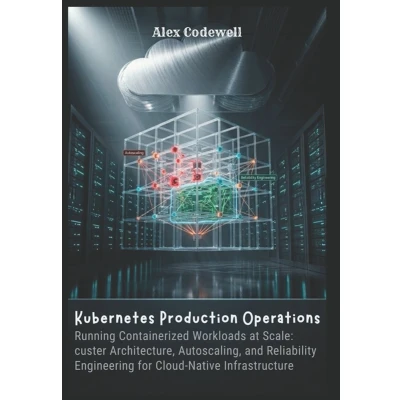
Kubernetes Production Operations Running Containerized Workloads at Scale: Cluster Architecture, Autoscaling, and Reliability Engineering for Cloud-Native Infrastructure
Uitgelicht

|
27,53 |
Naar shop
|

|
27,53 |
Naar shop
|

|
28,99 |
Naar shop
|
| VERGELIJK ALLE AANBIEDERS (3) | ||
 Beschrijving
Bol
Kubernetes dominates container orchestration because it solved a real problem: human operators cannot manually place, recover, and scale workloads across hundreds of nodes. Yet the system that eliminated one layer of complexity introduced another. Born from Google's Borg but stripped of its homogeneous, privileged environment, Kubernetes evolved into a modular federation of semi-independent components-each with distinct failure modes, version cycles, and vendor priorities. This book examines Kubernetes not as a finished product, but as an ongoing architectural compromise. You will learn why the Container Runtime, Network, and Storage interfaces that freed the ecosystem from vendor lock-in simultaneously created unpredictable latency surfaces and policy conflicts. You will see how scheduler decisions collide with resource quotas, how network overlays amplify latency under pressure, and how autoscaling controllers can trigger destabilizing feedback loops. Through production postmortems from large-scale environments, the text reveals why workload failures are rarely singular-and why reasoning about cascading interactions is now the central skill of platform engineering. The book also confronts unresolved scaling tensions. Kubernetes was originally optimized for clusters of thousands of nodes; modern environments routinely exceed that boundary, forcing painful choices between vertical cluster growth and multi-cluster coordination. It traces the shift from treating clusters as permanent infrastructure to viewing them as disposable scheduling domains-a conceptual change that redefines reliability engineering for cloud-native systems. What You Will Learn - Why Kubernetes rejected Mesos's two-level scheduling-and how that centralized decision created today's fairness and preemption challenges - How CRI, CNI, and CSI abstractions solved vendor politics while fragmenting operational predictability - The real reason production postmortems blame interaction patterns, not individual components - Why autoscaling, resource quotas, and network overlays form a hidden feedback loop that can destabilize utilization - The architectural entropy created by admission controllers, custom resource definitions, and policy engines - When to scale vertically versus distributing across clusters, and why hybrid federation is becoming the dominant pattern If your team runs production Kubernetes at scale, this book delivers the architectural clarity and operational rigor to build systems that fail gracefully rather than catastrophically. Read it before your next postmortem.


 Beschrijving
(1)
Beschrijving
(1)
Kubernetes dominates container orchestration because it solved a real problem: human operators cannot manually place, recover, and scale workloads across hundreds of nodes. Yet the system that eliminated one layer of complexity introduced another. Born from Google's Borg but stripped of its homogeneous, privileged environment, Kubernetes evolved into a modular federation of semi-independent components-each with distinct failure modes, version cycles, and vendor priorities. This book examines Kubernetes not as a finished product, but as an ongoing architectural compromise. You will learn why the Container Runtime, Network, and Storage interfaces that freed the ecosystem from vendor lock-in simultaneously created unpredictable latency surfaces and policy conflicts. You will see how scheduler decisions collide with resource quotas, how network overlays amplify latency under pressure, and how autoscaling controllers can trigger destabilizing feedback loops. Through production postmortems from large-scale environments, the text reveals why workload failures are rarely singular-and why reasoning about cascading interactions is now the central skill of platform engineering. The book also confronts unresolved scaling tensions. Kubernetes was originally optimized for clusters of thousands of nodes; modern environments routinely exceed that boundary, forcing painful choices between vertical cluster growth and multi-cluster coordination. It traces the shift from treating clusters as permanent infrastructure to viewing them as disposable scheduling domains-a conceptual change that redefines reliability engineering for cloud-native systems. What You Will Learn - Why Kubernetes rejected Mesos's two-level scheduling-and how that centralized decision created today's fairness and preemption challenges - How CRI, CNI, and CSI abstractions solved vendor politics while fragmenting operational predictability - The real reason production postmortems blame interaction patterns, not individual components - Why autoscaling, resource quotas, and network overlays form a hidden feedback loop that can destabilize utilization - The architectural entropy created by admission controllers, custom resource definitions, and policy engines - When to scale vertically versus distributing across clusters, and why hybrid federation is becoming the dominant pattern If your team runs production Kubernetes at scale, this book delivers the architectural clarity and operational rigor to build systems that fail gracefully rather than catastrophically. Read it before your next postmortem.
 Productspecificaties
 Prijshistorie
* Prijshistorie bevat geen data van Amazon, Amazon Marketplace.
Prijzen voor het laatst bijgewerkt op:
 Gerelateerde resultaten


