


€ 176,00 Gratis verzending

Uitgelicht
|
|
176,00 |
Naar shop
|

|
201,40 |
Naar shop
|

|
201,40 |
Naar shop
|
| VERGELIJK ALLE AANBIEDERS (3) | ||
 Beschrijving
Vergelijk aanbieders (3)
€ 176,00 Gratis verzending
€ 201,40 Gratis verzending
€ 201,40 Gratis verzending
Winkels met andere maten
Beschrijving
(1)
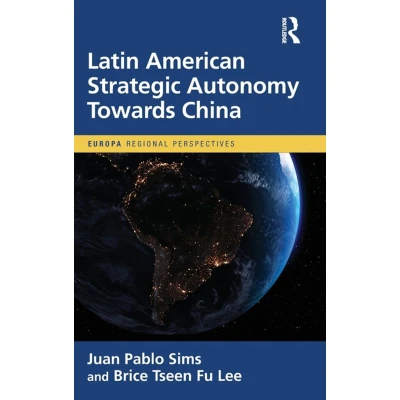
This volume offers a new explanation as to why Latin American and Caribbean governments respond so differently to the growing presence in the Western Hemisphere of the People’s Republic of China. This volume offers a new explanation as to why Latin American and Caribbean governments respond so differently to the growing presence in the Western Hemisphere of the People’s Republic of China. Rather than treating the region as a passive recipient of Chinese influence, this book demonstrates that domestic institutional conditions, state capacity, political stability and economic fundamentals systematically shape how governments interpret, negotiate and position themselves toward Chinese diplomatic engagement. Drawing on a large corpus of diplomatic speeches, topic modelling, set-theoretic comparison and focused case studies of Chile, Venezuela and Mexico, the volume identifies four distinct response profiles and traces the mechanisms that produce them. It further shows that all autonomy strategies operate within a domain-differentiated constraint environment structured by US hemispheric preponderance, where the costs of engaging China vary sharply across policy domains. The volume makes for essential reading for scholars and advanced students in international relations, international political economy and Latin American studies, providing a rigorous framework for understanding how smaller states navigate great-power competition under structural constraint.
 Prijshistorie
 * Prijshistorie bevat geen data van Amazon, Amazon Marketplace.
Prijzen voor het laatst bijgewerkt op:
 Gerelateerde resultaten
 Productspecificaties


