


€ 19,00 € 2,99 verzendkosten Totaal € 21,99

Gesponsorde links
|
|
19,00 |
Naar shop
|

|
20,16 |
Naar shop
|

|
20,16 |
Naar shop
|
| VERGELIJK ALLE AANBIEDERS (3) | ||
 Beschrijving
Vergelijk aanbieders (3)
Gesponsorde links · Sommige shops betalen ons een vergoeding
€ 19,00 € 2,99 verzendkosten Totaal € 21,99
€ 20,16 Gratis verzending
€ 20,16 Gratis verzending
Winkels met andere maten
Beschrijving
(1)
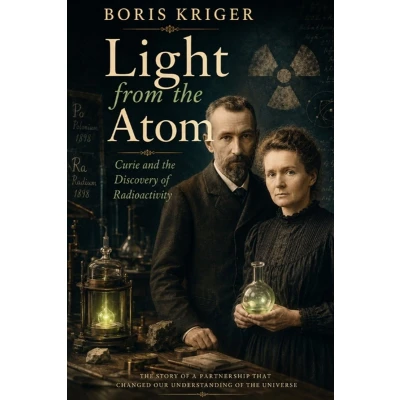
In the spring of 1898 a young woman with no laboratory of her own placed a pinch of uranium ore between two metal plates and read a number off a quartz electrometer built by her husband and his brother. The number was too large. It was larger than the uranium in the sample could account for, and from that single excess she announced the existence of two elements that nobody had ever seen, weighed, or held. It took four more years to produce a tenth of a gram of one of them. The other she never isolated at all. This is the story of how Pierre and Marie Curie turned a smudge on a photographic plate into a measurable quantity, and then turned a measurable quantity into a new picture of matter. It is also a story about a habit of mind that has since become the working method of physics: measure first, and only then decide what exists. Boris Kriger follows the Curies from a piezoelectric crystal in a Paris cellar to a sealed glass tube in a vault at Sevres that became the international standard of radioactivity; from a converted dissecting room where a tonne of Bohemian pitchblende was boiled down by hand to the field hospitals of the Western Front, where twenty vehicles and two hundred installations put X-rays within reach of a million wounded men. Along the way he examines the pieces of the story that the familiar legend leaves out: the priority that Marie lost to a German chemist by a matter of weeks; the burn that Pierre deliberately inflicted on his own arm and then timed; the forty new elements announced between 1898 and 1913, most of which quietly ceased to be elements when isotopes were understood; the heat that radium gives off forever, which for a few years appeared to break the conservation of energy; and the 1995 exhumation that revised the most famous cause of death in the history of science. The Curies are not presented here as saints of the laboratory. They are presented as two people with complementary talents, one for extracting numbers from nature and one for deciding what those numbers were permitted to mean, who together did something more consequential than discovering radium. They established the terms on which invisible things are allowed into science, and paid for it with their health, their privacy, and eventually their lives. >KEYWORDS radioactivity, Marie Curie, Pierre Curie, radium, measurement, scientific discovery, history of physics
 Prijshistorie
* Prijshistorie bevat geen data van Amazon, Amazon Marketplace.
Prijzen voor het laatst bijgewerkt op:
 Gerelateerde resultaten
 Productspecificaties


