


€ 198,65 Gratis verzending

Uitgelicht
|
|
198,65 |
Naar shop
|
| VERGELIJK ALLE AANBIEDERS (1) | ||
 Beschrijving
Vergelijk aanbieders (1)
€ 198,65 Gratis verzending
Winkels met andere maten
Beschrijving
(1)
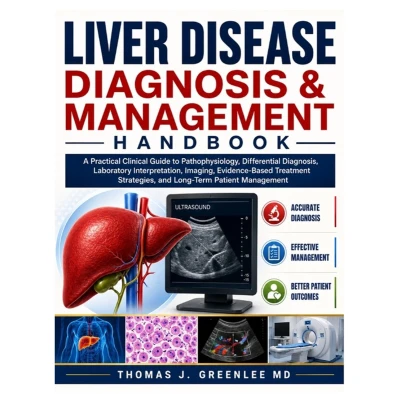
You're staring at a liver panel, and you still can't tell what's wrong.ALT, AST, ALP, bilirubin, INR. You know the names. You've seen them a hundred times. But the pattern doesn't say anything to you yet.Someone asks whether this is cirrhosis, and you give a hedged answer instead of a clear one.You order extra tests just in case, because you're not sure which one matters here.A patient asks why their belly is swelling, and your explanation doesn't quite land.You tell yourself you'll read up tonight. By next week it's faded again.That isn't a memory problem, and it isn't a sign you're behind.Almost every liver book is written by specialists, for specialists. They open at step four and assume you were there for steps one through three. They name a scoring system without explaining what question it answers.You were handed the answers. Nobody walked you through the thinking, in order, once.Liver disease is not a hundred topics to memorize.It's a small set of questions, asked in the same order, every time. Cells or ducts? Acute or chronic? Is there portal hypertension? Is the liver still doing its job? Is this patient stable today?Learn the order and the field shrinks to something you can hold.Imagine the next patient with abnormal liver tests.You see a pattern instead of a list. You know which test to send next, and why. When the attending asks what you think, you answer in a full sentence.Not because you memorized more. Because you finally understand what you're looking at.No dense jargon. No 900 pages. No assumed background.WHAT YOU'LL BE ABLE TO DO- Separate a hepatocellular pattern from a cholestatic one in seconds- Work up jaundice in a clear order instead of ordering everything at once- Explain portal hypertension, ascites, varices, and encephalopathy in plain language- Know when ascites needs a tap and what the fluid is telling you- Use MELD and Child-Pugh without memorizing a formula- Tell fatty liver that needs lifestyle work from fatty liver that's already scarring- Read a hepatitis B or C serology panel without a chart in front of you- Spot the patient who needs help today versus the one who can wait for clinic- Know when to call a hepatologist, and what to have ready when you do- Follow real cases from first abnormal result to final decisionYou go from "I'll look this up later" to "I know what this is, and what comes next."WHO THIS IS FORMedical and nursing students, residents, nurse practitioners, physician assistants, and any clinician who cares for liver patients without being a liver specialist.Liver disease is quiet until it isn't. The patients missed early arrive decompensated later, when the options have narrowed.The gap won't close on its own.Scroll up and start reading today.
 Productspecificaties
| EAN |
|
|---|---|
| Maat |
|
 Prijshistorie
 Prijzen voor het laatst bijgewerkt op:
 Gerelateerde resultaten


