


€ 37,92 Gratis verzending

Uitgelicht
|
|
37,92 |
Naar shop
|
| VERGELIJK ALLE AANBIEDERS (1) | ||
 Beschrijving
Vergelijk aanbieders (1)
€ 37,92 Gratis verzending
Winkels met andere maten
Beschrijving
(1)
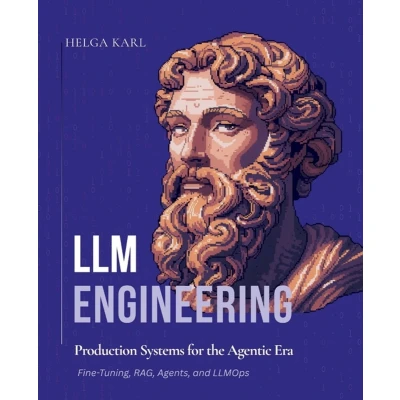
Instead of focusing on isolated techniques, this book gives you a complete systems-level approach-combining fine-tuning, retrieval, agents, and LLMOps into one cohesive engineering discipline. Inside, you'll learn how to: - Design LLM systems that work reliably beyond the "happy path"- Choose between prompting, RAG, and fine-tuning with clear decision frameworks- Build scalable inference pipelines with predictable latency and cost- Fine-tune models efficiently using LoRA, QLoRA, and modern alignment methods- Implement retrieval systems that actually improve accuracy (not just complexity)- Architect agent systems that can plan, act, and recover from failure- Evaluate LLM outputs with rigorous, production-ready metrics- Optimize performance across cost, latency, and quality trade-offs- Deploy, monitor, and maintain LLM systems using real LLMOps practices Along the way, you'll build/create: - A model routing system that dynamically selects the cheapest model for each task- A complete fine-tuning pipeline with evaluation and deployment- A production-grade RAG system with hybrid retrieval and re-ranking- A multi-agent system with tool use and orchestration- A full LLM production stack deployed with observability, guardrails, and CI/CDThis book is for software engineers, ML engineers, AI practitioners, and technical leaders who are moving from experimentation to real-world deployment.If you already understand the basics of LLMs but struggle with reliability, scaling, or system design-this is the missing piece.What sets this book apart: - It focuses on production systems, not toy examples- It provides end-to-end architecture, not isolated techniques- It emphasizes engineering trade-offs and decision-making, not hypeBy the time you finish the book, you would have learned how LLMs work- how to ship them, scale them, and trust them in production.
 Productspecificaties
| EAN |
|
|---|---|
| Maat |
|
 Prijshistorie
 Prijzen voor het laatst bijgewerkt op:
 Gerelateerde resultaten


