
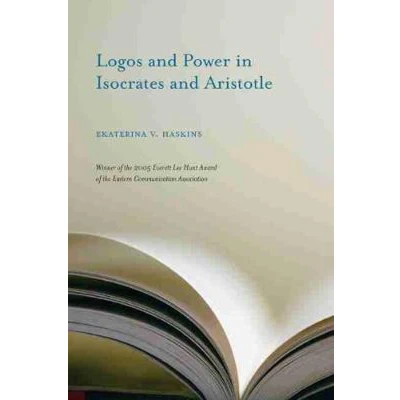
Logos and Power in Isocrates Aristotle
Uitgelicht

|
17,95 |
Naar shop
|
| VERGELIJK ALLE AANBIEDERS (1) | ||
 Beschrijving
Bol Partner
Presents Isocrates' vision of discourse as a worthy rival, rather than a mere precursor, of Aristotle's Rhetoric. This book argues that much of what Aristotle had to say about the status of rhetoric and the role of discourse in the life of a Greek city-state may have been an implicit reaction to Isocrates. This work offers a provocative reconsideration of two competing classical approaches to discourse, politics, and education. ""Logos and Power in Isocrates and Aristotle"" presents Isocrates' vision of discourse as a worthy rival, rather than a mere precursor, of Aristotle's Rhetoric. Casting Isocrates and Aristotle as opponents in a debate over the character, resources, and ends of rhetorical education, Ekaterina V. Haskins argues that much of what Aristotle had to say about the status of rhetoric and the role of discourse in the life of a Greek city-state may have been an implicit reaction to Isocrates. Haskins finds that Isocrates offers a more comprehensive and culturally attuned theory of civic discourse and education than does Aristotle, whose intellectual project disengages moral philosophy from the contingencies of public culture and introduces rhetoric merely as an art serviceable to a philosophically trained statesman. Haskins terms Isocrates' approach to discourse 'constitutive' and Aristotle's 'instrumental' and shows how the former is more congenial to the goals of contemporary rhetorical theory and pedagogy.


Vergelijk aanbieders (1)

 Beschrijving
(1)
Beschrijving
(1)
Presents Isocrates' vision of discourse as a worthy rival, rather than a mere precursor, of Aristotle's Rhetoric. This book argues that much of what Aristotle had to say about the status of rhetoric and the role of discourse in the life of a Greek city-state may have been an implicit reaction to Isocrates. This work offers a provocative reconsideration of two competing classical approaches to discourse, politics, and education. ""Logos and Power in Isocrates and Aristotle"" presents Isocrates' vision of discourse as a worthy rival, rather than a mere precursor, of Aristotle's Rhetoric. Casting Isocrates and Aristotle as opponents in a debate over the character, resources, and ends of rhetorical education, Ekaterina V. Haskins argues that much of what Aristotle had to say about the status of rhetoric and the role of discourse in the life of a Greek city-state may have been an implicit reaction to Isocrates. Haskins finds that Isocrates offers a more comprehensive and culturally attuned theory of civic discourse and education than does Aristotle, whose intellectual project disengages moral philosophy from the contingencies of public culture and introduces rhetoric merely as an art serviceable to a philosophically trained statesman. Haskins terms Isocrates' approach to discourse 'constitutive' and Aristotle's 'instrumental' and shows how the former is more congenial to the goals of contemporary rhetorical theory and pedagogy.
 Productspecificaties
| EAN |
|
|---|---|
| Maat |
|
 Prijshistorie
Prijzen voor het laatst bijgewerkt op:
 Gerelateerde resultaten


