

€ 16,60 Gratis verzending

Gesponsorde links
|
|
16,60 |
Naar shop
|

|
16,60 |
Naar shop
|

|
18,00 |
Naar shop
|
| VERGELIJK ALLE AANBIEDERS (3) | ||
 Beschrijving
Vergelijk aanbieders (3)
Gesponsorde links · Sommige shops betalen ons een vergoeding
€ 16,60 Gratis verzending
€ 16,60 Gratis verzending
€ 18,00 € 2,99 verzendkosten Totaal € 20,99
Winkels met andere maten
Beschrijving
(1)
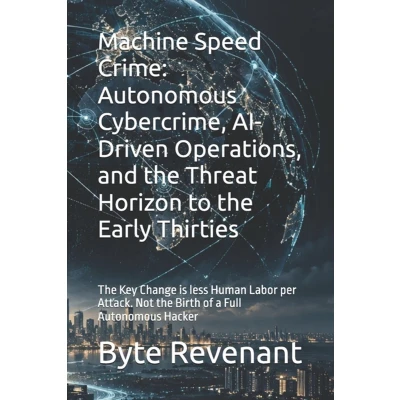
Artificial intelligence is changing cybercrime-but not in the way the most dramatic headlines suggest.The real transformation is quieter, more practical, and already underway.Cybercriminals are using AI to research targets, write and modify code, interpret unfamiliar systems, analyze stolen data, manage infrastructure, support vulnerability exploitation, improve social engineering, and automate parts of post-compromise operations. Agentic systems are beginning to move beyond answering questions and toward executing multi-step workflows, correcting errors, invoking tools, and operating across multiple targets with less continuous human involvement.Machine-Speed Crime examines what happens when those capabilities mature.Rather than predicting a world of fully autonomous "AI hackers," Byte Revenant traces a more credible and potentially more disruptive transition: cybercrime with fewer human bottlenecks.The book investigates how AI changes the economics and tempo of criminal operations. Reconnaissance can become continuous. Initial access can become more personalized. Exploit-development cycles can compress. Malware and infrastructure can become more adaptive. Stolen information can be triaged at machine scale. Extortion can become a data-driven decision process. Hybrid disruption can combine technical attacks with synthetic media and information manipulation. Criminal teams may remain small while supervising increasingly large software-defined operations.At the same time, the attack itself may become harder to see.Future intrusions may rely less on obviously malicious files and more on stolen identities, legitimate cloud platforms, SaaS services, APIs, AI agents, administrative tools, and machine credentials. The challenge for defenders becomes not simply identifying malicious software, but distinguishing malicious intent from activity that technically resembles ordinary digital work.Grounded in state-of-the-art 2026 evidence, the book separates what is documented, what can reasonably be assessed, and what remains projected for the period approaching 2030-2032.Machine-Speed Crime is not a book about science-fiction cyberwar. It is a book about the industrialization of decision-making inside cybercrime.The machines do not need motives. They do not need to become criminals. They only need to make criminal operations faster, cheaper, more scalable, and more difficult to distinguish from legitimate activity.That transition has already begun.
 Prijshistorie
* Prijshistorie bevat geen data van Amazon, Amazon Marketplace.
Prijzen voor het laatst bijgewerkt op:
 Gerelateerde resultaten
 Productspecificaties


