
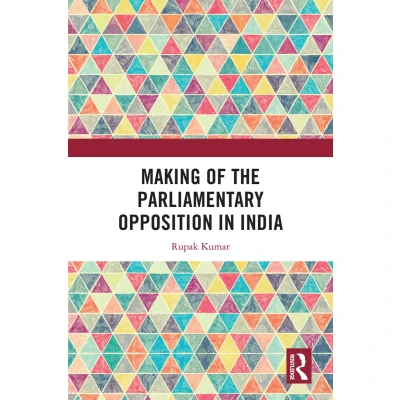
Making of the Parliamentary Opposition in India
Uitgelicht

|
175,00 |
Naar shop
|
| VERGELIJK ALLE AANBIEDERS (1) | ||
 Beschrijving
Bol
This book is a detailed account of the making of parliamentary opposition in Independent India. It examines the working of the Opposition in four phases –the Formative Phase (1952-1966), the Resilience Phase (1967-1984), the Consolidation Phase (1985-1999), and the Fragmentation Phase (1999-2014). This book is a detailed historical and analytical account of the making of parliamentary opposition in Independent India, based on a wide range of sources, including the memoirs of politicians and their writings in the popular press. Historically, the book examines the working of the Opposition in four phases –the Formative Phase (1952-1966), the Resilience Phase (1967-1984), the Consolidation Phase (1985-1999), and the Fragmentation Phase (1999-2014); parallelly, the question of the Opposition is framed in two facets: as democracy’s necessity and as governance imperative. It shows how the representational assertion in Indian politics enabled the expansion of the Opposition, but by generating fragmentation and making ideologically-neutral coalitions both possible and necessary, it also contributed to its weakening as a mechanism of exacting accountability. This book invites the reader to reimagine the idea of democracy, political system, governance from the perspective of the opposition. Why is the Opposition essential? What is the constitutional and institutional protection to ensure an effective and vibrant opposition under one party dominant system? It also adopts a narrative style, making it accessible to all kinds of readers. This book will be useful to those interested in understanding Indian politics, democracy, political processes and institutions. Students, researchers, academics of political science, governance and policy makers will find this work engaging.


Vergelijk aanbieders (1)

 Beschrijving
(1)
Beschrijving
(1)
This book is a detailed account of the making of parliamentary opposition in Independent India. It examines the working of the Opposition in four phases –the Formative Phase (1952-1966), the Resilience Phase (1967-1984), the Consolidation Phase (1985-1999), and the Fragmentation Phase (1999-2014). This book is a detailed historical and analytical account of the making of parliamentary opposition in Independent India, based on a wide range of sources, including the memoirs of politicians and their writings in the popular press. Historically, the book examines the working of the Opposition in four phases –the Formative Phase (1952-1966), the Resilience Phase (1967-1984), the Consolidation Phase (1985-1999), and the Fragmentation Phase (1999-2014); parallelly, the question of the Opposition is framed in two facets: as democracy’s necessity and as governance imperative. It shows how the representational assertion in Indian politics enabled the expansion of the Opposition, but by generating fragmentation and making ideologically-neutral coalitions both possible and necessary, it also contributed to its weakening as a mechanism of exacting accountability. This book invites the reader to reimagine the idea of democracy, political system, governance from the perspective of the opposition. Why is the Opposition essential? What is the constitutional and institutional protection to ensure an effective and vibrant opposition under one party dominant system? It also adopts a narrative style, making it accessible to all kinds of readers. This book will be useful to those interested in understanding Indian politics, democracy, political processes and institutions. Students, researchers, academics of political science, governance and policy makers will find this work engaging.
 Productspecificaties
| EAN |
|
|---|---|
| Maat |
|
 Prijshistorie
Prijzen voor het laatst bijgewerkt op:
 Gerelateerde resultaten


