
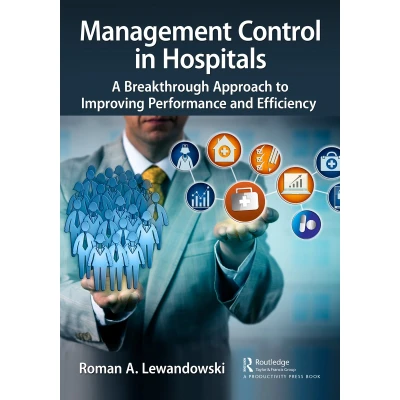
Management Control in Hospitals
Uitgelicht

|
68,99 |
Naar shop
|
| VERGELIJK ALLE AANBIEDERS (1) | ||
 Beschrijving
Bol
This book comprehensively presents issues related to management control and develops a breakthrough theory about management control in hospitals. It is the result of many years of research and outlines the concept of control and related theories which are discussed in detail. For years, problems related to health-care efficiency have been at the top of the priorities of many hospitals systems and governments. The growing cost of health care, and particularly hospitals, is a significant factor in the increasing pressure for improvement of hospitals’ efficiency while maintaining a high quality of services. Hospitals are recognized as organizations in which waste, unnecessary administrative burdens, failures of care coordination, failures in execution of care processes, and even fraud and abuse are frequently identified as causes. Adoption of management control as a response to hospital problems is consistent with the conviction that control is a critical management function that has the greatest impact on organizational performance. Research proves that the lack of adequate control, adapted to modern organizational solutions, causes many harmful consequences, such as faulty services, dissatisfied patients and employees, inability to effectively compete on market, low flexibility and innovativeness, and, consequently, poor performance of the organization. This book comprehensively presents issues related to management control and develops a breakthrough theory about management control in hospitals. It is the result of many years of research and outlines the concept of control and related theories, which are discussed in detail, taking into account the unique characteristics of medical services, the health-care market, and hospitals as public organizations. Research has shown that the main elements of management control in hospitals are information systems, diagnostic control, interactive control, innovativeness, manager’s trust in physicians, and perceived uncertainty. And that proper relationships between these elements positively influence the hospital’s performance. This book describes how the success of the entire control process is based on the hospital’s top management and its interaction with clinical managers, department heads, and directors of other medical departments as well as clinicians. After reading this book, the implementation of the solutions suggested will help hospitals improve their performance, including the quality and effectiveness of the provided medical services and patient care.


Vergelijk aanbieders (1)

 Beschrijving
(1)
Beschrijving
(1)
This book comprehensively presents issues related to management control and develops a breakthrough theory about management control in hospitals. It is the result of many years of research and outlines the concept of control and related theories which are discussed in detail. For years, problems related to health-care efficiency have been at the top of the priorities of many hospitals systems and governments. The growing cost of health care, and particularly hospitals, is a significant factor in the increasing pressure for improvement of hospitals’ efficiency while maintaining a high quality of services. Hospitals are recognized as organizations in which waste, unnecessary administrative burdens, failures of care coordination, failures in execution of care processes, and even fraud and abuse are frequently identified as causes. Adoption of management control as a response to hospital problems is consistent with the conviction that control is a critical management function that has the greatest impact on organizational performance. Research proves that the lack of adequate control, adapted to modern organizational solutions, causes many harmful consequences, such as faulty services, dissatisfied patients and employees, inability to effectively compete on market, low flexibility and innovativeness, and, consequently, poor performance of the organization. This book comprehensively presents issues related to management control and develops a breakthrough theory about management control in hospitals. It is the result of many years of research and outlines the concept of control and related theories, which are discussed in detail, taking into account the unique characteristics of medical services, the health-care market, and hospitals as public organizations. Research has shown that the main elements of management control in hospitals are information systems, diagnostic control, interactive control, innovativeness, manager’s trust in physicians, and perceived uncertainty. And that proper relationships between these elements positively influence the hospital’s performance. This book describes how the success of the entire control process is based on the hospital’s top management and its interaction with clinical managers, department heads, and directors of other medical departments as well as clinicians. After reading this book, the implementation of the solutions suggested will help hospitals improve their performance, including the quality and effectiveness of the provided medical services and patient care.
 Productspecificaties
| EAN |
|
|---|---|
| Maat |
|
 Prijshistorie
Prijzen voor het laatst bijgewerkt op:
 Gerelateerde resultaten


