


€ 51,92 Gratis verzending

Gesponsorde links
|
|
51,92 |
Naar shop
|

|
54,29 |
Naar shop
|

|
54,29 |
Naar shop
|
| VERGELIJK ALLE AANBIEDERS (3) | ||
 Beschrijving
Vergelijk aanbieders (3)
Gesponsorde links · Sommige shops betalen ons een vergoeding
€ 51,92 Gratis verzending
€ 54,29 Gratis verzending
€ 54,29 Gratis verzending
Winkels met andere maten
Beschrijving
(1)
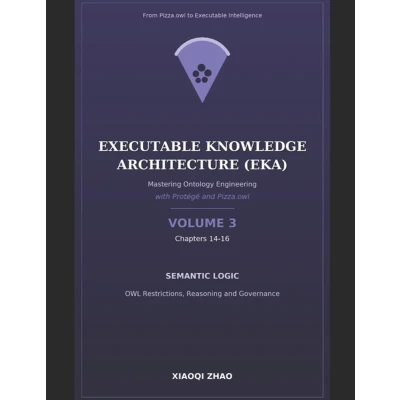
You have mastered classes and properties. Now learn how to turn your ontology into a reasoning engine.Volume 3 of Mastering Ontology Engineering with Protégé and Pizza.owl completes the transition from semantic structure to semantic logic. It introduces OWL property restrictions - the fundamental mechanism that transforms a connected ontology into a machine-interpretable knowledge model capable of validation, inference, and governance.This volume covers: - Why RDF and RDFS Are Not Enough - understand the limits of structural semantics and why OWL's logical expressiveness matters- Existential Restrictions (some) - require that at least one qualifying relationship exists, establishing semantic obligations- Universal Restrictions (only) - constrain what relationships are allowed, creating semantic boundaries and preventing data pollution- The Classic VegetarianPizza Pattern - combine existential and universal restrictions to define concepts with logical precision- OWL vs. Neo4j - implement the same restrictions in Cypher queries and understand why OWL reasoning is fundamentally different from graph querying- EKA Governance - map property restrictions to the five layers of Executable Knowledge Architecture: Knowledge Graph (KK), Reasoning (RR), Triggers (ΘΘ), Execution (ΦΦ), and Governance (ΓΓ)- Common Mistakes - avoid the traps that beginners (and even experienced modelers) fall intoEvery concept is demonstrated step by step with the Pizza ontology - complete with screenshots, RDF examples, and hands-on Protégé exercises.What makes this volume unique: - Logic meets engineering - property restrictions are explained through formal logic, Description Logic semantics, and real-world enterprise examples- Cross-platform perspective - compare OWL's Open World reasoning with Neo4j's Closed World querying- Governance as the goal - understand why restrictions are not just syntax, but the foundation of semantic governanceThis volume assumes you have worked through Volumes 1-2 or are already comfortable with OWL classes, object properties, and domain and range. If you have wondered how to move beyond classification and begin expressing logical meaning, Volume 3 is your answer.Each chapter includes hands-on Protégé exercises, complete with ontology snapshots you can load and inspect. All materials are open source (CC BY-SA 4.0) and available from the companion GitHub repository.Whether you are building enterprise knowledge graphs, AI-ready semantic models, or formalizing domain expertise, Volume 3 gives you the logical tools to engineer meaning that machines can interpret and reason over.Start with pizza. End with meaning.
 Prijshistorie
* Prijshistorie bevat geen data van Amazon, Amazon Marketplace.
Prijzen voor het laatst bijgewerkt op:
 Gerelateerde resultaten
 Productspecificaties


