


€ 33,99 Gratis verzending

Uitgelicht
|
|
33,99 |
Naar shop
|

|
50,85 |
Naar shop
|

|
50,85 |
Naar shop
|
| VERGELIJK ALLE AANBIEDERS (3) | ||
 Beschrijving
Vergelijk aanbieders (3)
€ 33,99 Gratis verzending
€ 50,85 € 3,00 verzendkosten Totaal € 53,85
€ 50,85 € 3,00 verzendkosten Totaal € 53,85
Winkels met andere maten
Beschrijving
(1)
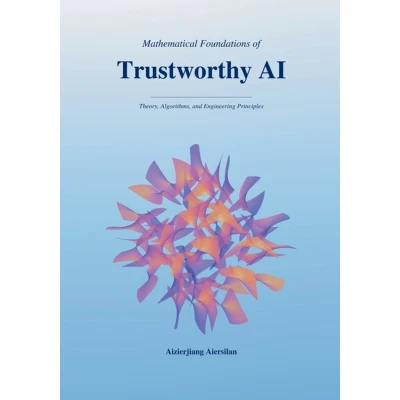
Mathematical Foundations of Trustworthy AI: Theory, Algorithms, and Engineering Principles offers a systematic, textbook-style treatment of the mathematics behind safe, fair, private, and reliable machine learning. It brings together, under a single cover, the core theoretical results from constrained optimization, statistical learning theory, and differential geometry that underpin robustness, fairness, privacy, explainability, causality, and safety in modern AI systems.The book is organized into five parts and a comprehensive appendix: - Part I - Foundations & Theory: notation, the necessity of trust, and statistical learning theory (concentration inequalities, VC dimension, Rademacher complexity, PAC learning, algorithmic stability, double descent).- Part II - Robustness, Fairness, Privacy: adversarial attacks (FGSM, PGD, C&W, AutoAttack) and certified defenses via randomized smoothing; group, individual, and causal fairness with impossibility theorems (Kleinberg-Chouldechova); differential privacy with composition, Rényi DP, and DP-SGD accounting.- Part III - Interpretability & Causality: Shapley values, LIME, integrated gradients, concept-based XAI; structural causal models, the do-calculus, counterfactuals, front-door adjustment, and algorithmic recourse.- Part IV - Distributed Learning & Decision Making: federated learning (FedAvg, FedProx, Byzantine robustness); safe reinforcement learning (CMDPs, control barrier functions, RLHF, DPO); out-of-distribution detection and conformal prediction.- Part V - Engineering, Governance, Frontiers: formal verification of neural networks, MLOps for trustworthy AI, AI governance; Lipschitz and monotonic networks, robust statistics, shuffle-model privacy; trustworthy agentic AI and open research directions.Appendices supply mathematical prerequisites, extended proofs, reference Python implementations, evaluation metrics, and a glossary of key terms.Throughout, trust is treated as a quantifiable property rather than a slogan: every informal desideratum is reduced to mathematical objects with explicit guarantees, sample complexities, or impossibility results. Each theorem is paired with a worked example, a Python implementation, or an evaluation protocol, so the chain from theory to deployable algorithm is never left implicit. Each chapter includes worked problems and exercises.Intended for graduate students, researchers, and practitioners who seek precise mathematical statements, rigorous proofs, and concrete examples in the rapidly evolving field of Trustworthy AI.
 Prijshistorie
 * Prijshistorie bevat geen data van Amazon, Amazon Marketplace.
Prijzen voor het laatst bijgewerkt op:
 Gerelateerde resultaten
 Productspecificaties


