

€ 38,95 Gratis verzending

Gesponsorde links
|
|
38,95 |
Naar shop
|

|
40,40 |
Naar shop
|
| VERGELIJK ALLE AANBIEDERS (2) | ||
 Beschrijving
Vergelijk aanbieders (2)
Gesponsorde links · Sommige shops betalen ons een vergoeding
€ 38,95 Gratis verzending
€ 40,40 Gratis verzending
Winkels met andere maten
Beschrijving
(1)
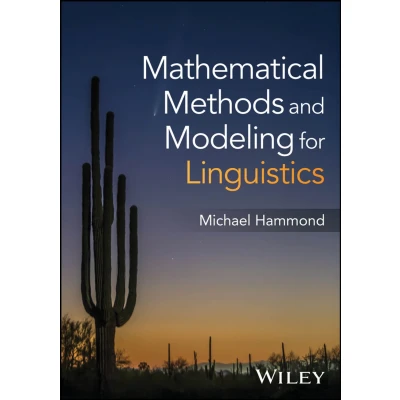
A linguist's pathway from foundational mathematics to computational and formal analysis The mathematical structures underpinning linguistics are deep and pervasive, yet students in formal and theoretical linguistics rarely encounter them systematically. Without this foundation, the transition to computational linguistics, natural language processing, or formal semantics remains unnecessarily difficult. Mathematical Methods and Modeling for Linguistics demonstrates that core theories of language can be understood mathematically and that exploring these interconnections both enriches linguistic study and prepares students to pursue advanced work in theoretical and computational fields. Coverage progresses methodically through strings and lists, sets, sentential logic, predicate logic, modal and temporal logic, type theory and lambda calculus, and formal language theory. Each topic is developed within a linguistic context, connecting abstract formalism directly to phonology, morphology, and semantics. Written in a conversational tone requiring only minimal prior mathematical knowledge, the book includes a companion website with Haskell code demonstrating concepts from every chapter, though all examples transfer readily to any preferred programming language. Designed for advanced undergraduates and graduate students in formal linguistics, computational linguistics, and natural language processing, this book also serves students of semantics, morphology, cognitive linguistics, and philosophical logic. It functions as a primary textbook for courses in mathematical or computational linguistics and as a structured resource for independent study. Connect mathematical concepts to linguistic theory without advanced math prerequisites There is a strong relationship between mathematics and linguistic theory, yet students in linguistics programs rarely encounter these connections systematically. Mathematical Methods and Modeling for Linguistics demonstrates that basic theories of language can be understood mathematically and that exploring these interconnections enriches linguistic study while preparing students for advanced work in all fields of linguistics. Assuming only minimal familiarity with mathematics, this book introduces and covers concepts such as strings and lists, sets, sentential logic, predicate logic, modal and temporal logic, type theory and lambda calculus, and formal language theory. A companion website provides sample code written in Haskell to demonstrate concepts from every chapter, though students may use any preferred programming language or ignore the code sections entirely. Readers will also find: A conversational writing style that removes barriers to mathematical study for students across linguistics subfields and related disciplines Direct applications of mathematical reasoning to phonology, morphology, and semantics, connecting abstract formalisms to concrete linguistic phenomena Coverage of logic traditions relevant to formal semantics, cognitive linguistics, and the philosophy of language Suitable as a textbook for courses in mathematical linguistics, computational linguistics, and natural language processing and for self-directed study Structured content supporting both classroom instruction and independent study at the advanced undergraduate and graduate levels Designed for advanced undergraduates and graduate students in formal linguistics, computational linguistics, and natural language processing, this book also serves students of cognitive linguistics, logic, philosophy of language, and other aeras, who seek rigorous mathematical grounding in linguistic theory.
 Prijshistorie
* Prijshistorie bevat geen data van Amazon.
Prijzen voor het laatst bijgewerkt op:
 Gerelateerde resultaten
 Productspecificaties


