


€ 85,99 Gratis verzending

Uitgelicht
|
|
85,99 |
Naar shop
|
| VERGELIJK ALLE AANBIEDERS (1) | ||
 Beschrijving
Vergelijk aanbieders (1)
€ 85,99 Gratis verzending
Winkels met andere maten
Beschrijving
(1)
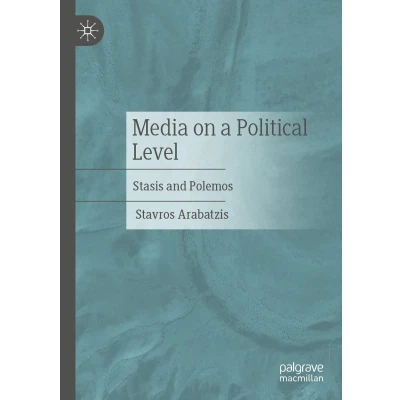
The volume presented here seeks to shift the concept of “media” from its traditional domain to the political field. Media are not merely to be understood as an intellectual or aesthetic game—whether communicative, linguistic, textual, technical, profit-rational, instrumental, hermeneutic, or mathematical-informational—but rather as a political state of emergency. This media theory therefore addresses the question posed by Adorno and Horkheimer: “Why humanity, instead of entering a truly human state, is sinking into a new kind of barbarism?” According to our thesis, this is a medial question—one that arises from the original “inverse setting” (kata-strophen) of media and subsequently shapes their historical, societal, artistic, and political development. The central thesis of this book is that media can no longer be regarded as a theoretical, technical-aesthetic, or informational game. Rather, they must be understood as a political state of emergency, where the stakes are truth or falsehood within the polis and its prevailing laws. These are two fundamentally distinct domains—intellectual and aesthetic play on the one hand, and political emergency on the other, where the explosive potential of art is absorbed into the political—that must not be confused, because the latter is existential and concerns life or death. The Author PD Dr. Stavros Arabatzis teaches at the University of Cologne, at the Institute for Art and Art Theory, in the fields of design theory, art theory, and media theory. His research and publications focus on media theory, art theory, design theory, and the philosophy of media. Most recently, he developed a new media-theoretical approach in the field of media pharmacology. He is a member of the editorial board of the ITS Journal Art and Design (AD), based in Hong Kong and London. He has also recently authored expert reviews for doctoral scholarship programs on behalf of the Presidium of the Austrian Academy of Sciences. The translation was done with the help of artificial intelligence. A subsequent human revision was done primarily in terms of content. This book is a translation of an original German edition. The translation was done with the help of artificial intelligence (machine translation by the service DeepL.com). A subsequent human revision was done primarily in terms of content, so that the book will read stylistically differently from a conventional translation. The volume presented here seeks to shift the concept of “media” from its traditional domain to the political field. Media are not merely to be understood as an intellectual or aesthetic game (communicative, linguistic, written, technical, profit-rational, instrumental, hermeneutic, or mathematical-informational), but rather as a political state of emergency. This “media theory” therefore addresses the question of “why humanity, instead of entering a truly human state, is sinking into a new kind of barbarism” (Adorno/Horkheimer). According to our thesis, this is a medial question—one that arises from the original „inverse setting” (kata-strophen) of media—and it subsequently determines their historical, societal, social, and political development. The main thesis of this book is that we are no longer dealing with media as a theoretical, technical-aesthetic, or informational game. Rather, we are dealing with a political state of emergency, where the issue is truth or falsehood within the polis and its prevailing laws. These are two fundamentally different domains—intellectual and aesthetic play on the one hand, and political emergency on the other—that must not be confused, because the latter is existential and concerns life or death. Today, media themselves have become cultural, technical, economic, and political “weapons,” concealing both their “essence” and “non-essence.” As a result, the once metaphorical character of “technicist media theory”—“war as the essence of media” (Kittler)—has been lost, and media have been transferred into the political, geopolitical, financial, and informational-economic realm. Kittler’s media-theoretical thesis (media as “military equipment”: media as repurposed war devices, misunderstood in their function as long as their primary military purpose is ignored) is, according to our thesis in this book, not to be understood as “technical,” but as political (state-related) and socio-economic (pre-state). Media theory thus becomes Stasiology (theory of civil war) and Polemology (theory of war). This antagonistic-polemical principle sharpens the focus on all media in the public sphere, such that the “agonistic” principle of struggle (C. Mouffe) is merely a preliminary stage and still remains within the realm of play. Therefore, our concluding thesis is that we do not need a technical, hermeneutic, aesthetic, phenomenological, anthropological, or ontological a priori to explain the essence or non-essence of media. What we need is a Stasiology and a Polemology capable of unlocking the entire antagonistic-polemical field of media in the public sphere. Only this sharpening of media in the public sphere allows us to move beyond the antagonistic-polemical principle itself.
 Productspecificaties
| EAN |
|
|---|---|
| Maat |
|
 Prijshistorie
 Prijzen voor het laatst bijgewerkt op:
 Gerelateerde resultaten


