


€ 67,94 Gratis verzending

Uitgelicht
|
|
67,94 |
Naar shop
|

|
74,29 |
Naar shop
|

|
74,29 |
Naar shop
|
| VERGELIJK ALLE AANBIEDERS (3) | ||
 Beschrijving
Vergelijk aanbieders (3)
€ 67,94 Gratis verzending
€ 74,29 Gratis verzending
€ 74,29 Gratis verzending
Winkels met andere maten
Beschrijving
(1)
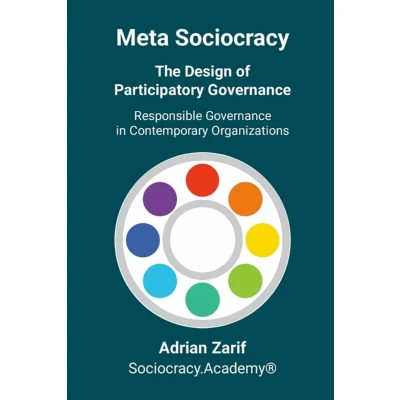
What if participation did not depend on permission or good will, but was guaranteed by structure itself? Meta Sociocracy - The Design of Participatory Governance presents a new approach to organizational governance designed for the realities of complexity, distributed collaboration, and institutional adaptability. At its core lies a powerful premise: meaningful participation cannot rely on culture alone. It must be structurally enabled. Many organizations aspire to transparency, inclusion, and shared responsibility, yet continue to operate through hidden power gradients, informal influence, and centralized decision dependency. As complexity increases, these tensions become harder to manage. Participation becomes symbolic, initiative weakens, and governance slowly drifts back toward hierarchy. Meta Sociocracy offers a different path. Built upon the Bearing Governance Model (BGM) and the Consent-Based Scoring Protocol (CBSP), this book introduces a post-hierarchical governance architecture in which Functional Units operate through clearly defined domains, explicit responsibilities, and structurally distributed decision rights. Governance is no longer treated as authority concentrated at the center, but as a participatory capability embedded across the organization. The framework introduces concepts such as Structural Equivalence, Enhanced Equivalence, Initiative Activation Rights, the Meta Circle, and federated Circle Constellations-creating conditions in which autonomy, coordination, and organizational coherence can coexist without centralized control. More than a theoretical proposal, this book explores how governance can become adaptive, auditable, and capable of learning from its own decisions. It examines how organizations can redesign participation, process objections constructively, reduce structural dependency patterns, and develop Governance Intelligence. Written for founders, organizational designers, executives, facilitators, consultants, institutional innovators, and governance practitioners, this work offers both conceptual depth and practical structural insight for those seeking governance systems capable of sustaining participation at real organizational scale. This is not a book about improving hierarchy through better behavior. It is a book about redesigning governance so that responsibility, participation, and initiative become structural realities rather than managerial intentions. Governance evolves when structure evolves.
 Prijshistorie
 * Prijshistorie bevat geen data van Amazon, Amazon Marketplace.
Prijzen voor het laatst bijgewerkt op:
 Gerelateerde resultaten
 Productspecificaties


