
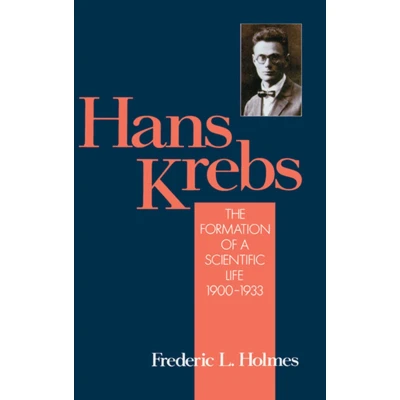
Monographs on the History and Philosophy of Biology Hans Krebs
Uitgelicht

|
64,99 |
Naar shop
|

|
95,23 |
Naar shop
|
| VERGELIJK ALLE AANBIEDERS (2) | ||
 Beschrijving
Bol Partner
This second and final volume of the biography of Hans Krebs covers his early years in England, 1933-1937, when he laid the foundations of our modern understanding of intermediary metabolism. This comprehensive volume completes Frederic Holmes's notable and detailed biography of Hans Krebs, from the investigator's early development through the major phase of his groundbreaking investigation, which lay the foundations upon which the modern structure of intermediary metabolism is built. With access to Krebs's research notebooks as well as to Krebs himself through more than five years of personal interviews, the author provides an insightful analysis of Hans Krebs and of the scientific process as a whole. The first volume, published in 1991, covered Krebs's formative years in Germany, his work with Otto Warburg, and his discovery of the urea cycle in 1932. This second volume reconstructs the investigative pathway and the professional and personal life of Hans Krebs, from the time of his arrival in England in 1933 until 1937, when he made the discovery for which he is best known--the formulation of the citric acid cycle. Holmes portrays Krebs's activity at the intimate level of daily interactions of thought and action, from which the characteristic patterns of scientific creativity can best be seen. Holmes's fascinating portrait of Krebs integrates the great scientist's investigative pathways with his personal life. The result is an illuminating analysis of both man and scientist that will be of interest to biochemists and historians of science.


 Beschrijving
(2)
Beschrijving
(2)
This second and final volume of the biography of Hans Krebs covers his early years in England, 1933-1937, when he laid the foundations of our modern understanding of intermediary metabolism. This comprehensive volume completes Frederic Holmes's notable and detailed biography of Hans Krebs, from the investigator's early development through the major phase of his groundbreaking investigation, which lay the foundations upon which the modern structure of intermediary metabolism is built. With access to Krebs's research notebooks as well as to Krebs himself through more than five years of personal interviews, the author provides an insightful analysis of Hans Krebs and of the scientific process as a whole. The first volume, published in 1991, covered Krebs's formative years in Germany, his work with Otto Warburg, and his discovery of the urea cycle in 1932. This second volume reconstructs the investigative pathway and the professional and personal life of Hans Krebs, from the time of his arrival in England in 1933 until 1937, when he made the discovery for which he is best known--the formulation of the citric acid cycle. Holmes portrays Krebs's activity at the intimate level of daily interactions of thought and action, from which the characteristic patterns of scientific creativity can best be seen. Holmes's fascinating portrait of Krebs integrates the great scientist's investigative pathways with his personal life. The result is an illuminating analysis of both man and scientist that will be of interest to biochemists and historians of science.
BolThe biography of one of the world's foremost biochemists, which traces his scientific career and his discoveries of the urea cycle and the citric acid cycle. The text makes use of five years of interviews with Hans Krebs, and a complete set of Krebs' key laboratory notebooks. This is the first volume of the definitive biography of Hans Krebs, one of the world's foremost biochemists. It begins with the early work of Krebs in Germany, where, working with Otto Warburg, he discovered the urea cycle in 1932. This early achievement, coupled with the discovery of the citric acid cycle, are viewed as the foundations upon which the modern structure of intermediary metabolism is built. During the writing of this fascinating history, the author not only had access to a complete set of Krebs' key laboratory notebooks, but to the man himself through five years of insightful interviews. Holmes captures Krebs' activities at a level of intimacy that reveals scientific creativity at work. The story weaves together the investigative pathway with the professional and personal life of the investigator. The Krebs biography is certain to fascinate biochemists and historians of science alike.
 Productspecificaties
| EAN |
|
|---|---|
| Maat |
|
 Prijshistorie
Prijzen voor het laatst bijgewerkt op:
 Gerelateerde resultaten


