
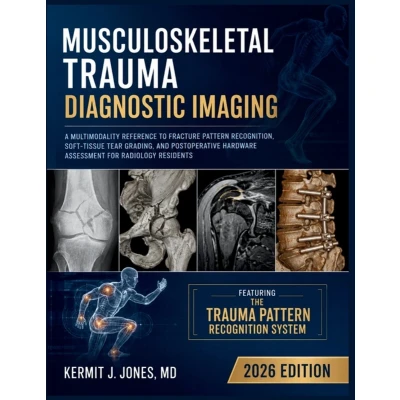
Musculoskeletal Trauma Diagnostic Imaging 2026: A Multimodality Reference to Fracture Pattern Recognition, Soft-Tissue Tear Grading, and Postoperative Hardware Assessment for Radiology Residents
Uitgelicht

|
219,00
215,00 |
Naar shop
|
| VERGELIJK ALLE AANBIEDERS (1) | ||
 Beschrijving
Bol
Musculoskeletal Trauma Diagnostic Imaging 2026 gives radiology residents a structured way to interpret fractures, dislocations, soft-tissue injuries, pediatric trauma, safeguarding patterns, postoperative constructs, and advanced imaging protocols. Built around mechanism-based pattern recognition, it connects radiographic alignment, CT fracture geometry, MRI marrow and soft-tissue signal, ultrasound dynamics, nuclear medicine localization, and arthrographic surface assessment to the decisions that determine stability, surgery, follow-up, and urgent communication.The book's Trauma Pattern Recognition System helps readers move from visible clue to associated-injury search, modality pivot, trap logic, and report anchor.- Decode fracture and dislocation patterns by region - from shoulder, elbow, wrist, pelvis, hip, knee, ankle, foot, and spine trauma to the associated injuries each mechanism predicts.- Select the right modality for the question - radiographs for alignment, CT for articular geometry and hardware trajectory, MRI for occult fracture and soft-tissue injury, and ultrasound or SPECT/CT when targeted answers matter.- Grade tendon, ligament, muscle, meniscal, labral, cartilage, and peripheral nerve trauma - with report language that describes completeness, retraction, instability, denervation, and repair relevance.- Interpret pediatric trauma safely - including buckle, greenstick, physeal, transitional, apophyseal, growth-arrest, and safeguarding injury patterns.- Assess postoperative hardware by function - identifying union, nonunion, malunion, pseudoarthrosis, loosening, migration, joint penetration, infection, and recurrent soft-tissue repair failure.- Avoid common misses and mimics - accessory ossicles, subtle dislocations, occult fractures, Lisfranc injuries, syndesmotic instability, physeal injuries, and metal-artifact pitfalls.- Use the Master Atlas at the workstation - converting fragments, malalignment, marrow edema, hardware lucency, and repair defects into management-ready impressions.Choose this reference to make every trauma report clearer, more complete, and more useful to the team treating the injury.


Vergelijk aanbieders (1)

 Beschrijving
(1)
Beschrijving
(1)
Musculoskeletal Trauma Diagnostic Imaging 2026 gives radiology residents a structured way to interpret fractures, dislocations, soft-tissue injuries, pediatric trauma, safeguarding patterns, postoperative constructs, and advanced imaging protocols. Built around mechanism-based pattern recognition, it connects radiographic alignment, CT fracture geometry, MRI marrow and soft-tissue signal, ultrasound dynamics, nuclear medicine localization, and arthrographic surface assessment to the decisions that determine stability, surgery, follow-up, and urgent communication.The book's Trauma Pattern Recognition System helps readers move from visible clue to associated-injury search, modality pivot, trap logic, and report anchor.- Decode fracture and dislocation patterns by region - from shoulder, elbow, wrist, pelvis, hip, knee, ankle, foot, and spine trauma to the associated injuries each mechanism predicts.- Select the right modality for the question - radiographs for alignment, CT for articular geometry and hardware trajectory, MRI for occult fracture and soft-tissue injury, and ultrasound or SPECT/CT when targeted answers matter.- Grade tendon, ligament, muscle, meniscal, labral, cartilage, and peripheral nerve trauma - with report language that describes completeness, retraction, instability, denervation, and repair relevance.- Interpret pediatric trauma safely - including buckle, greenstick, physeal, transitional, apophyseal, growth-arrest, and safeguarding injury patterns.- Assess postoperative hardware by function - identifying union, nonunion, malunion, pseudoarthrosis, loosening, migration, joint penetration, infection, and recurrent soft-tissue repair failure.- Avoid common misses and mimics - accessory ossicles, subtle dislocations, occult fractures, Lisfranc injuries, syndesmotic instability, physeal injuries, and metal-artifact pitfalls.- Use the Master Atlas at the workstation - converting fragments, malalignment, marrow edema, hardware lucency, and repair defects into management-ready impressions.Choose this reference to make every trauma report clearer, more complete, and more useful to the team treating the injury.
 Productspecificaties
| EAN |
|
|---|---|
| Maat |
|
 Prijshistorie
Prijzen voor het laatst bijgewerkt op:
 Gerelateerde resultaten


