
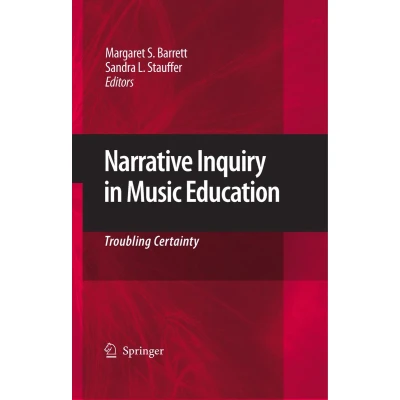
Narrative Inquiry in Music Education
Uitgelicht

|
105,99 |
Naar shop
|
| VERGELIJK ALLE AANBIEDERS (1) | ||
 Beschrijving
Bol
The purpose of this book is to explore the “narrative turn” in music education, to - amine the uses of narrative inquiry for music education, and to cultivate ground for narrative inquiry to seed and ourish alongside other methodological approaches in music education. This text provides a forum for the presentation and discussion of narrative inquiry approaches to research in music education, and contextualizes this work within the larger conversations of music education research and practice. In an innovative dialogic approach the text is divided into 3 parts, each presenting a different perspective on the uses and purposes of narrative in and for music education. Section I explores the origins of narrative research across a range of fields of inquiry and presents a conception of narrative inquiry as "resonant work". Section II provides 7 examples of narrative inquiry research, each of which is accompanied by a reflective commentary. The commentaries provide an interpretive perspective of the narrative accounts, suggest further questions that arise from the inquiry, and provide insight into the potential uses of the narrative account for the theory and practice of music education. Section III brings together the perspectives of two eminent theorists and practitioners. Margaret S. Barrett and Sandra L. Stauffer We live in a “congenial moment for stories” (Pinnegar & Daynes, 2007, p. 30), a time in which narrative has taken up a place in the “landscape” of inquiry in the social sciences. This renewed interest in storying and stories as both process and product (as eld text and research text) of inquiry may be attributed to various methodological and conceptual “turns,” including the linguistic and cultural, that have taken place in the humanities and social sciences over the past decades. The purpose of this book is to explore the “narrative turn” in music education, to - amine the uses of narrative inquiry for music education, and to cultivate ground for narrative inquiry to seed and ourish alongside other methodological approaches in music education. In a discipline whose early research strength was founded on an alignment with thesocialsciences,particularlythepsychometrictradition,oneofthekeychallenges for those embarking on narrative inquiry in music education is to ensure that its use is more than that of a “musical ornament,” an elaboration on the established themes of psychometric inquiry, those of measurement and certainty. We suggest that narrative inquiry is more than a “turn” (as noun), “a melodic embellishment that is played around a given note” (Encarta World English Dictionary, 2007, n. p. ); it is more than elaborationon a position, the adding of extra notes to make a melody more beautiful or interesting.


Vergelijk aanbieders (1)

 Beschrijving
(1)
Beschrijving
(1)
The purpose of this book is to explore the “narrative turn” in music education, to - amine the uses of narrative inquiry for music education, and to cultivate ground for narrative inquiry to seed and ourish alongside other methodological approaches in music education. This text provides a forum for the presentation and discussion of narrative inquiry approaches to research in music education, and contextualizes this work within the larger conversations of music education research and practice. In an innovative dialogic approach the text is divided into 3 parts, each presenting a different perspective on the uses and purposes of narrative in and for music education. Section I explores the origins of narrative research across a range of fields of inquiry and presents a conception of narrative inquiry as "resonant work". Section II provides 7 examples of narrative inquiry research, each of which is accompanied by a reflective commentary. The commentaries provide an interpretive perspective of the narrative accounts, suggest further questions that arise from the inquiry, and provide insight into the potential uses of the narrative account for the theory and practice of music education. Section III brings together the perspectives of two eminent theorists and practitioners. Margaret S. Barrett and Sandra L. Stauffer We live in a “congenial moment for stories” (Pinnegar & Daynes, 2007, p. 30), a time in which narrative has taken up a place in the “landscape” of inquiry in the social sciences. This renewed interest in storying and stories as both process and product (as eld text and research text) of inquiry may be attributed to various methodological and conceptual “turns,” including the linguistic and cultural, that have taken place in the humanities and social sciences over the past decades. The purpose of this book is to explore the “narrative turn” in music education, to - amine the uses of narrative inquiry for music education, and to cultivate ground for narrative inquiry to seed and ourish alongside other methodological approaches in music education. In a discipline whose early research strength was founded on an alignment with thesocialsciences,particularlythepsychometrictradition,oneofthekeychallenges for those embarking on narrative inquiry in music education is to ensure that its use is more than that of a “musical ornament,” an elaboration on the established themes of psychometric inquiry, those of measurement and certainty. We suggest that narrative inquiry is more than a “turn” (as noun), “a melodic embellishment that is played around a given note” (Encarta World English Dictionary, 2007, n. p. ); it is more than elaborationon a position, the adding of extra notes to make a melody more beautiful or interesting.
 Productspecificaties
| EAN |
|
|---|---|
| Maat |
|
 Prijshistorie
Prijzen voor het laatst bijgewerkt op:
 Gerelateerde resultaten


