


€ 149,00 Gratis verzending

Uitgelicht
|
|
149,00 |
Naar shop
|

|
157,36 |
Naar shop
|
| VERGELIJK ALLE AANBIEDERS (2) | ||
 Beschrijving
Vergelijk aanbieders (2)
€ 149,00 Gratis verzending
€ 157,36 Gratis verzending
Winkels met andere maten
Beschrijving
(1)
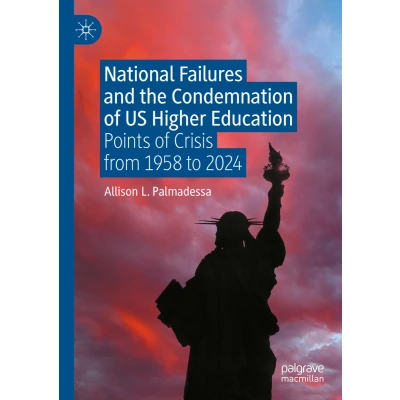
Since the first American colonial colleges, higher education has served the nation as an arbiter of knowledge, conduit of democratic idealism, and producer of leaders, workers, and innovation. Since the first American colonial colleges, higher education has served the nation as an arbiter of knowledge, conduit of democratic idealism, and producer of leaders, workers, and innovation. As the nation changed alongside world events and technological advancement, postsecondary institutions supported growth, met demands from the public and private sectors as well as states and the federal government, heeding a call to perpetuate the US’s position among nations as the undisputed world leader. This was most evident in the immediate post World War II era, with roots established much earlier. Each chapter in this work focuses on a moment of crisis in American history that involves the relationship of higher education to national goals. This work aims to fill a gap in the history of higher education and further our understanding of how an institution so appreciated in times of greatness can be rebranded by critics as negligent and harmful to national goals. Allison L. Palmadessa is Chair of the Department of History, Professor of History at Greensboro College, USA. She is the author of American National Identity, Policy Paradigms, and Higher Education: A History of the Relationship between Higher Education and the United States, 1862-2015 (2017, Palgrave Macmillan); Higher Education Divided: National Expectations and the Bifurcation of National Identity, 1946-2016 (2020, Palgrave Macmillan); and Power, Discourse, and the Purpose of Policy in Higher Education: A Genealogical Study of the Higher Education Act (2023, Palgrave MacMillan). Since the first American colonial colleges, higher education has served the nation as an arbiter of knowledge, conduit of democratic idealism, and producer of leaders, workers, and innovation. As the nation changed alongside world events and technological advancement, postsecondary institutions supported growth, met demands from the public and private sectors as well as states and the federal government, heeding a call to perpetuate the US’s position among nations as the undisputed world leader. This was most evident in the immediate post World War II era, with roots established much earlier. Each chapter in this work focuses on a moment of crisis in American history that involves the relationship of higher education to national goals. This work aims to fill a gap in the history of higher education and further our understanding of how an institution so appreciated in times of greatness can be rebranded by critics as negligent and harmful to national goals.
 Prijshistorie
 * Prijshistorie bevat geen data van Amazon.
Prijzen voor het laatst bijgewerkt op:
 Gerelateerde resultaten
 Productspecificaties


