

€ 23,19 Gratis verzending

Uitgelicht
|
|
23,19 |
Naar shop
|

|
23,19 |
Naar shop
|

|
24,00 |
Naar shop
|
| VERGELIJK ALLE AANBIEDERS (3) | ||
 Beschrijving
Vergelijk aanbieders (3)
€ 23,19 Gratis verzending
€ 23,19 Gratis verzending
€ 24,00 € 2,99 verzendkosten Totaal € 26,99
Winkels met andere maten
Beschrijving
(1)
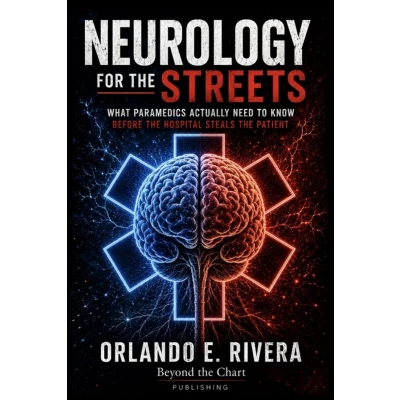
The brain does not always fail loudly.Sometimes it begins with a word that will not come. A hand that slowly turns inward. A patient who cannot stand even though the stroke screen is negative. A family member who keeps saying, "This is not normal."Neurology for the Streets is a practical, field-focused guide for paramedics, EMTs, flight clinicians, nurses, and emergency professionals who need to recognize neurologic danger before the diagnosis is clear.This is not a dense neurology textbook or a treatment manual built around memorizing rare syndromes. It is a book about judgment.Written by Orlando E. Rivera, DNP, MBA, RN, EMT-P, this book breaks down the neurologic emergencies that are easy to miss and impossible to afford missing. Using real-world scenarios, sharp clinical insight, and the language of the street, it teaches readers how to recognize dangerous patterns before imaging, laboratory results, or specialists provide the answer.Inside, readers will learn how to: Recognize subtle stroke findings and large vessel occlusion patterns.Identify posterior circulation strokes that may be missed by basic screening tools.Understand the warning signs of intracranial hemorrhage, transient ischemic attack, seizure, traumatic brain injury, and spinal cord emergencies.Distinguish neurologic emergencies from hypoglycemia, overdose, infection, psychiatric illness, and other common mimics.Assess children, older adults, pregnant patients, anticoagulated patients, dialysis patients, and other high-risk populations.Make stronger destination decisions and communicate neurologic findings with greater precision.Recognize when a patient is quietly deteriorating, even when the monitor appears reassuring.More importantly, this book teaches clinicians how to think when the presentation is incomplete.What changed?When did it change?What function was lost?What does not fit the easy explanation?Is the patient stable, improving, or getting worse?Neurology for the Streets shows why a negative screening tool does not always mean a normal brain, why temporary symptoms still matter, why baseline must be defined instead of assumed, and why the first clinician may be the only person who sees the original deficit.The hospital may eventually name the disease.But you met it first.For EMS professionals who want stronger neurologic assessment skills, sharper clinical reasoning, better stroke recognition, and greater confidence during high-stakes calls, this book delivers the practical insight traditional textbooks often leave behind.The brain gives clues.Sometimes only once.Learn to notice them.
 Prijshistorie
 * Prijshistorie bevat geen data van Amazon, Amazon Marketplace.
Prijzen voor het laatst bijgewerkt op:
 Gerelateerde resultaten
 Productspecificaties


