







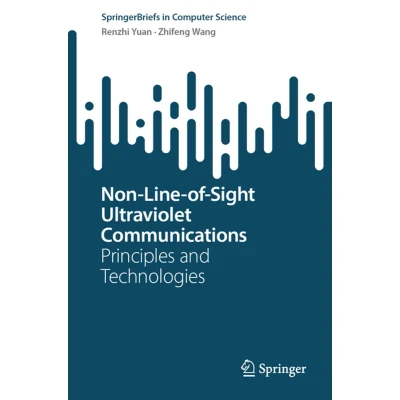
Non Line of Sight Ultraviolet Communications: Principles and Technologies
Uitgelicht

|
51,99 |
Naar shop
|
 Beschrijving
Bol
This book provides a comprehensive review and the latest progress of ultraviolet communications. Optical wireless communications employing electromagnetic waves in optical wavebands as information carriers can achieve higher communication bandwidth compared with radio frequency based wireless communication. However, the good directionality of optical waves degrades its non-line-of-sight transmission ability for avoiding obstacles. The ultraviolet communication employs the ultraviolet light in “solar blind” waveband (200–280 nm) as information carriers. The name “solar blind" is derived from the fact that the solar radiation in 200–280 nm is strongly absorbed by the ozone layer of the atmosphere such that little ultraviolet lights can reach the earth's surface. Therefore, ultraviolet communications enjoy low background radiation noise compared with other optical wireless communications. Besides, the strong absorption effect of ultraviolet lights in the atmosphere also guarantees a good local security due to the verified low-probability-of-detection. Therefore, the ultraviolet communication becomes a promising non-line-of-sight optical wireless communication technology and attracted increasing research attentions in recent decades. This book mainly focuses on the key principles and technologies of ultraviolet communications, including the channel modeling, achievable information rate, full-duplex ultraviolet communication, relay-assisted ultraviolet communication, non-line-of-sight ultraviolet positioning, and some future prospects of ultraviolet communications.


Vergelijk aanbieders (1)

 Beschrijving
(1)
Beschrijving
(1)
This book provides a comprehensive review and the latest progress of ultraviolet communications. Optical wireless communications employing electromagnetic waves in optical wavebands as information carriers can achieve higher communication bandwidth compared with radio frequency based wireless communication. However, the good directionality of optical waves degrades its non-line-of-sight transmission ability for avoiding obstacles. The ultraviolet communication employs the ultraviolet light in “solar blind” waveband (200–280 nm) as information carriers. The name “solar blind" is derived from the fact that the solar radiation in 200–280 nm is strongly absorbed by the ozone layer of the atmosphere such that little ultraviolet lights can reach the earth's surface. Therefore, ultraviolet communications enjoy low background radiation noise compared with other optical wireless communications. Besides, the strong absorption effect of ultraviolet lights in the atmosphere also guarantees a good local security due to the verified low-probability-of-detection. Therefore, the ultraviolet communication becomes a promising non-line-of-sight optical wireless communication technology and attracted increasing research attentions in recent decades. This book mainly focuses on the key principles and technologies of ultraviolet communications, including the channel modeling, achievable information rate, full-duplex ultraviolet communication, relay-assisted ultraviolet communication, non-line-of-sight ultraviolet positioning, and some future prospects of ultraviolet communications.
 Productspecificaties
| EAN |
|
|---|---|
| Maat |
|
 Prijshistorie
Prijzen voor het laatst bijgewerkt op:
 Gerelateerde resultaten


