

€ 22,66 Gratis verzending

Uitgelicht
|
|
22,66 |
Naar shop
|

|
22,66 |
Naar shop
|

|
24,99 |
Naar shop
|
| VERGELIJK ALLE AANBIEDERS (3) | ||
 Beschrijving
Vergelijk aanbieders (3)
€ 22,66 Gratis verzending
€ 22,66 Gratis verzending
€ 24,99 € 2,99 verzendkosten Totaal € 27,98
Winkels met andere maten
Beschrijving
(1)
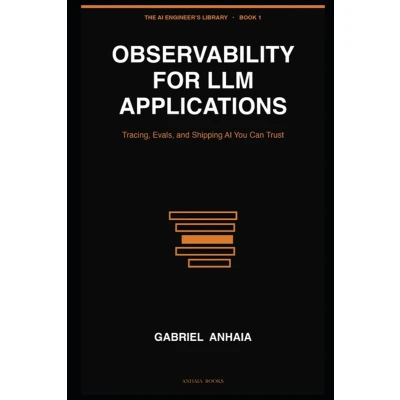
Your LLM feature went out at 2 a.m. last Thursday. Latency is fine. Error rate is zero. And somewhere, quietly, it is lying to a customer. Traditional observability cannot see this. CPU graphs, HTTP status codes, and p99 dashboards were built for systems that either work or crash. LLMs do neither. They return a confident sentence, the span closes green, and the failure lives in the content. If you ship LLM features in production - as a backend engineer, a platform engineer, an SRE who inherited someone else's prompt - this book is the operational handbook you have been missing. It is not a theory book about transformers. It is not a prompt engineering tour. It is the stack you actually need on Monday morning to know your AI works. What you get: the three new pillars (traces, evals, cost and drift metrics), built first on vendor-neutral OpenTelemetry GenAI semantic conventions, then layered with the tools that matter in 2026 - Langfuse, LangSmith, Arize Phoenix, Braintrust, DeepEval, Helicone, and a roll-your-own OTel Collector + ClickHouse + Grafana stack for teams that want everything in-house. Every tool gets an honest verdict: what it is best at, what it is bad at, when to pick it, what it costs. You will learn how to capture a full LLM decision path as a trace, run evals continuously in CI and in production, track token cost per user and per feature, detect drift before your users do, and write incident response runbooks for a failure mode your pager has never seen. Real code in Python, Go, and TypeScript. Real dashboards. Real traces. Complementary to Hamel Husain's Evals for AI Engineers (O'Reilly, 2026): where that book goes deep on eval methodology for ML engineers, this one covers the wider operational stack - tracing, tooling, cost, drift, and on-call - for the platform-engineer reader. By the end, you will have a production-readiness checklist you can run against your own system and mean it when you tell your boss the answer is yes. The first chapter starts with a real incident. Monday morning, you will have something to do. Book 1 of The AI Engineer's Library.
 Prijshistorie
 * Prijshistorie bevat geen data van Amazon, Amazon Marketplace.
Prijzen voor het laatst bijgewerkt op:
 Gerelateerde resultaten
 Productspecificaties


