


€ 21,00 € 2,99 verzendkosten Totaal € 23,99

Uitgelicht
|
|
21,00 |
Naar shop
|

|
21,90 |
Naar shop
|

|
21,90 |
Naar shop
|
| VERGELIJK ALLE AANBIEDERS (3) | ||
 Beschrijving
Vergelijk aanbieders (3)
€ 21,00 € 2,99 verzendkosten Totaal € 23,99
€ 21,90 Gratis verzending
€ 21,90 Gratis verzending
Winkels met andere maten
Beschrijving
(1)
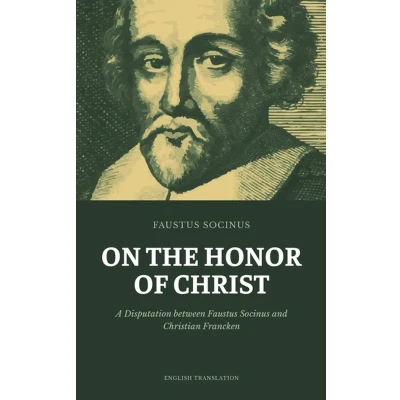
On the Glory of Christ - A Disputation between Fausto Sozzini and Christian Francken Should religious veneration be accorded to a being who is not God by nature? One of the most heated Christological controversies of the 16th century. At the heart of this disputation lies a question that touches upon the very core of the Christian faith: if Christ is a creature and not of the same essence as the Father, as the Council of Nicaea taught - how then can he be accorded the worship that is due to God alone? The philosopher Christian Francken argues with relentless logical rigour: the distance between Creator and creature is infinite; consequently, the difference in the honour due to them must also be infinite. To bestow divine worship upon a non-God would contradict the very wisdom of God.Faustus Socinus (1539-1604), founder of Socinianism-named after him-responds with equal parts precision and boldness: God may bestow his glory upon whomever he chooses. Christ's dignity does not stem from a supposed divine nature, but from the sovereign will of the Father, who has exalted his Son and given him all authority. Whoever honours the Son honours the Father who sent him - the worship of Christ is thus not a violation of the first commandment, but its consistent fulfilment. This edition makes one of the most significant texts of early modern Christology available in English for the first time. The accompanying notes reveal the logical structures of the argument - the fallacies that Sozzini exposes in his opponent's reasoning, and the scholastic distinction between what applies in the absolute sense (simpliciter) and what applies in a restricted sense (secundum quid). Here we see the art of disputation at its highest level, applied to a question of existential significance.The volume is supplemented by Socinus's fragments on the non-invocation of Christ (a reply to Franz David), Martin Seidel's letters, and further material that sheds light on a Europe-wide network of anti-Trinitarian scholars - men who often corresponded at the risk of their lives and established a community of free inquiry in Raków. Why this book today? Not because its answers need to be adopted, but because its questions remain unavoidable: What does it mean to worship Christ? What legitimises religious veneration? How do reason and revelation relate to one another when both lay claim to truth? 'Test everything; hold on to what is good' - this apostolic imperative hangs over Socinus's entire body of work. An indispensable source text for anyone interested in the history of theology, anti-Trinitarianism, Unitarianism, the history of the Reformation, and the roots of modern freedom of conscience and thought.
 Prijshistorie
 * Prijshistorie bevat geen data van Amazon, Amazon Marketplace.
Prijzen voor het laatst bijgewerkt op:
 Gerelateerde resultaten
 Productspecificaties


