


€ 15,00 € 2,99 verzendkosten Totaal € 17,99

Uitgelicht
|
|
15,00 |
Naar shop
|

|
50,99 |
Naar shop
|

|
50,99 |
Naar shop
|
| VERGELIJK ALLE AANBIEDERS (3) | ||
 Beschrijving
Vergelijk aanbieders (3)
€ 15,00 € 2,99 verzendkosten Totaal € 17,99
€ 50,99 Gratis verzending
€ 50,99 Gratis verzending
Winkels met andere maten
Beschrijving
(1)
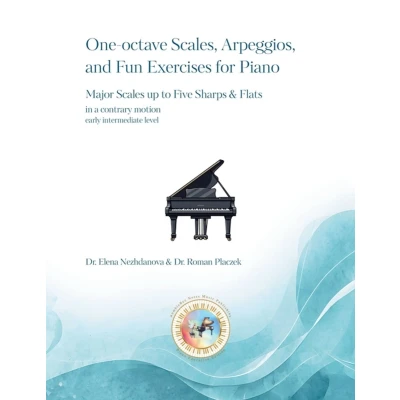
Scales, arpeggios, and exercises with surprises!Scales are the building blocks of music, found in every culture around the world. Each culture uses a series of tones to create unique melodies that express happiness, love, pleasure, wonder, memories, loss, and pain. Scales have their own beauty, and an instrument like the piano, which can play two scales at once, adds even more depth and meaning.Let's be honest, practicing scales isn't everyone's favorite activity, though it's important. That's why we worked to make this book enjoyable and interesting, so pianists can create a positive relationship with their lifelong companions, the scales.This volume is the first in a two-book series. The first volume contains one-octave scales and arpeggios up to five sharps and flats in contrary motion. The second volume presents the natural minor scales with up to four sharps and flats. These are the relative scales corresponding to those included here. Both volumes are intended for early intermediate-level piano students. The selection in both books is limited to five accidentals. Students proficient in all key signatures are generally expected to study and play two- or three-octave scales.To make the scale study more appealing and effective, each scale and arpeggio in our books is followed by an exercise: a single piece transposed to the key of that scale. The exercise is truly new only when studying the C major scale. For the following keys, play the transpositions to become familiar with new accidentals, add black keys, and later, various fingerings. This also improves notation-reading skills, as students verify their reading through unique repetition and memorization. The exercise uses only scale and arpeggio patterns, as in many concertos and sonatas. When performed expressively, it becomes appealing and highlights the value of daily scale practice.
 Prijshistorie
 * Prijshistorie bevat geen data van Amazon, Amazon Marketplace.
Prijzen voor het laatst bijgewerkt op:
 Gerelateerde resultaten
 Productspecificaties


