


€ 1.299,99 Gratis verzending

Uitgelicht
|
|
1.299,99 |
Naar shop
|
| VERGELIJK ALLE AANBIEDERS (2) | ||
 Beschrijving
Vergelijk aanbieders (2)
€ 1.299,99 Gratis verzending

€ 1.299,99 Gratis verzending
Winkels met andere maten
Beschrijving
(2)
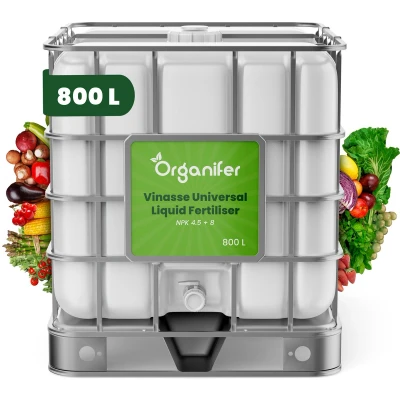
Vinasse – volledig plantaardig en snelwerkend Onmiddellijke werking door directe opname van de in de vorm van aminozuren aanwezige stikstof via het blad en door activering van het bodemleven. Naast de snelle meststofwerking door het blad en de activering van aanwezige voedingsstoffen in de bodem, heeft Vinasse een gunstige invloed op het bodemleven en bevordert het een gezonde bodemflora. Het resterende suikergehalte draagt aanzienlijk bij aan het stimuleren van de bodem. Hoewel de meetbare N-waarden in de bodem langzaam stijgen, treedt door de bladwerking onmiddellijk zichtbare versterking van de planten op. Gezonde groei Deze universele meststof zorgt voor een gezonde groei, vooral bij planten met zichtbare voedingstekorten zoals dwerggroei en geelachtige bladeren. Toepassingsgebieden Voornamelijk voor het nabemesten van lang staande gewassen. Vanwege de gunstige N-K-verhouding is Vinasse bijzonder geschikt voor sterk verbruikende, kaliumminnende gewassen zoals tomaten, komkommers en paprika’s. Productie Uit de suikerwinning. De organische vloeibare meststof in de biologische landbouw. Melasse van suikerbieten wordt gefermenteerd om de aanwezige restsuikers te winnen, bijvoorbeeld voor de productie van gist. Het resulterende residu is vervolgens vinasse. Samenstelling Organische NK-meststof vloeibaar 4.5 + 8 met 100% plantaardige stoffen uit voedselproductie.4,5 % N totaal stikstof,0, 3 % P2O5 totaal fosfaat0,4 % N direct beschikbare stikstof8,0 % K2O totaal kaliumoxide0,2 % zwavel0,02 % magnesium 50 % organisch materiaal als gloeiverlies 65 % droge stof gehalte Toepassing en dosering De juiste dosering voor Vinasse is afhankelijk van de behoefte van de planten en de grootte van het te bemesten gebied. Over het algemeen is 10 liter Vinasse voldoende voor bijna 200 m² bij een eenmalige dosering van 30 kg N/ha, of 800 liter voor 1,6 hectare. Vinasse wordt meestal gebruikt voor het bijbemesten en als bladvoeding of om het bodemleven te stimuleren. De dichtheid van Vinasse is 1,3 kg/liter. Een liter Vinasse bevat ongeveer 60 g N. Bij de aanbevolen concentratie van 1-2% voor jonge planten, brengt u 0,6-1,1 g N per liter water toe. 100 ml Vinasse op 10 liter water komt overeen met de aanbevolen 1% concentratie. Over het algemeen wordt wekelijks bemesten aanbevolen voor sterk consumerende gewassen. Bij bodembemesting of bestaande, minder gevoelige gewassen is een concentratie van 5% tot 10% effectief gebleken. Bij groenten: sterk consumerende planten zoals tomaten en snelgroeiende potplanten moeten wekelijks worden bemest, terwijl zwakke groeiers zoals kruiden en minder snelgroeiende vaste planten om de 2-4 weken bemest moeten worden. In de wijnbouw wordt na de bloei tot aan de vorming van de druiven 1% (10 liter Vinasse op 1000 liter water of spuitvloeistof) gebruikt. Bij nieuwe aanplantingen wordt het op elk moment aangebracht bij herkenbare stresssymptomen zoals gele bladeren. Aanbeveling voor bijbemesting: Bij een behoefte van 20 kg N/ha zijn bij een irrigatiegift van 4 mm en één gietbeurt 4 liter vinasse nodig per 100 m² gietoppervlakte. Belangrijk! – Goed spoelen – na het toevoegen aan irrigatiesystemen! De toevoer van Vinasse dient bij voorkeur plaats te vinden in de eerste helft of de eerste twee derde van de irrigatiegift. De snelheid van de werking: Een deel van de organisch gebonden stikstof is bijvoorbeeld bij toepassing via het blad direct werkzaam. IBC U mag de IBC behouden. Helaas is het vanwege de transportkosten niet mogelijk om een enkele IBC terug te nemen of te ruilen. Wanneer u echter een grote hoeveelheid heeft, is dit wel mogelijk. Neem dan contact met ons op via e-mail en wij sturen u een passende offerte. Het weergegeven aankoopbedrag is inclusief de IBC. Bewaren Vinasse is een dikke en aangenaam ruikende vloeistof, maar kan dikker worden en de vloeibaarheid kan verslechteren bij koud weer. Kristallisatie van restsuikers kan afzettingen in de container veroorzaken, die opgelost kunnen worden door spoelen in water. Bij hevige schokken kan er schuimvorming ontstaan, die gestopt kan worden door er wat kalk aan toe te voegen. Onverdunde vinasse kan bijna onbeperkt worden opgeslagen, maar na een langere opslagperiode moet het krachtig worden geroerd. Verdunde vinasse moet op korte termijn worden gebruikt, omdat de gisting snel kan beginnen met bijbehorende geuren en verlies van voedingsstoffen.
OrganiferVinasse - Fully Plant-Based and Fast-Acting Immediate effect through the direct uptake of nitrogen present in the form of amino acids via the foliage and by activating soil life. In addition to the rapid fertilisation action through the leaves and the activation of existing nutrients in the soil, Vinasse positively influences soil life and promotes a healthy soil flora. The remaining sugar content significantly contributes to stimulating the soil. Although the measurable N-values in the soil rise slowly, the foliar action results in an immediately visible strengthening of the plants. Healthy Growth This universal fertiliser ensures healthy growth, particularly in plants showing visible nutritional deficiencies such as stunted growth and yellowish leaves. Areas of Application Primarily for the follow-up fertilisation of long-standing crops. Due to the favourable N-K ratio, Vinasse is especially suitable for high-consuming, potassium-loving crops such as tomatoes, cucumbers, and peppers. Production From sugar extraction. The organic liquid fertiliser in organic farming. Molasses from sugar beets is fermented to extract the residual sugars, for instance, for yeast production. The resulting residue is then vinasse. Composition Organic NK Fertiliser Liquid 4.5 + 8 with 100% plant-based substances from food production. 4.5% N total nitrogen, 0.3% P2O5 total phosphate, 0.4% N immediately available nitrogen, 8.0% K2O total potassium oxide, 0.2% sulphur, 0.02% magnesium, 50% organic material as loss on ignition, 65% dry matter content. Application and Dosage The correct dosage for Vinasse depends on the needs of the plants and the size of the area to be fertilised. Generally, 10 litres of Vinasse is sufficient for nearly 200 m² with a one-time dosage of 30 kg N/ha, or 800 litres for 1.6 hectares. Vinasse is typically used for supplementary fertilisation and as foliar feed or to stimulate soil life. The density of Vinasse is 1.3 kg/litre. One litre of Vinasse contains approximately 60 g N. At the recommended concentration of 1-2% for young plants, you add 0.6-1.1 g N per litre of water. 100 ml of Vinasse in 10 litres of water corresponds to the recommended 1% concentration. Generally, weekly fertilisation is recommended for high-consuming crops. For soil fertilisation or existing, less sensitive crops, a concentration of 5% to 10% has proven effective. For vegetables: high-consuming plants such as tomatoes and fast-growing potted plants should be fertilised weekly, while slow growers such as herbs and less rapidly growing perennials should be fertilised every 2-4 weeks. In viticulture, 1% (10 litres of Vinasse in 1000 litres of water or spray liquid) is used from post-blooming until grape formation. In new plantings, it is applied at any time upon recognisable stress symptoms such as yellow leaves. Recommendation for supplementary fertilisation: For a requirement of 20 kg N/ha with an irrigation application of 4 mm and one watering, 4 litres of vinasse are needed per 100 m² of watering area. Important! - Rinse thoroughly - after adding to irrigation systems! The application of Vinasse should ideally take place in the first half or the first two-thirds of the irrigation application. Speed of action: A portion of the organically bound nitrogen, for example, when applied via the foliage, is immediately effective. IBC You may keep the IBC. Unfortunately, due to transport costs, it is not feasible to take back or exchange a single IBC. However, if you have a large quantity, this can be arranged. Please contact us via email, and we will send you a suitable quote. The purchase amount displayed includes the IBC. Storage Vinasse is a thick and pleasantly smelling liquid, but it can thicken and its fluidity may deteriorate in cold weather. Crystallisation of residual sugars can cause deposits in the container, which can be dissolved by rinsing in water. Severe jolts can cause foaming, which can be stopped by adding some lime. Undiluted vinasse can be stored almost indefinitely, but after a long storage period, it must be vigorously stirred. Diluted vinasse should be used in the short term, as fermentation can quickly begin, accompanied by odours and loss of nutrients.
 Prijshistorie
 Prijzen voor het laatst bijgewerkt op:
 Gerelateerde resultaten
 Productspecificaties


