
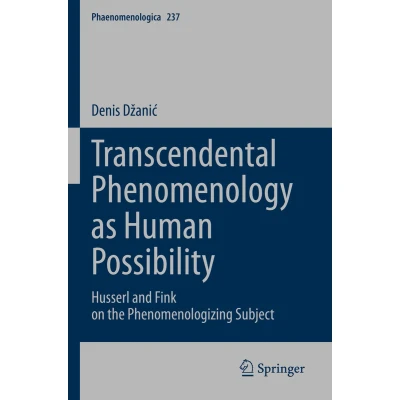
Phaenomenologica237 Transcendental Phenomenology as Human Possibility
Uitgelicht

|
119,00
115,00 |
Naar shop
|
| VERGELIJK ALLE AANBIEDERS (1) | ||
 Beschrijving
Bol
This book focuses on Edmund Husserl’s philosophical collaboration with Eugen Fink which took place in the early 1930s, and shows how their disagreement over the nature, origin, and aim of phenomenology led to a crucial divergence on the issue of who was engaging in phenomenology, and with what motivation. This book focuses on Edmund Husserl’s philosophical collaboration with Eugen Fink which took place in the early 1930s, and shows how their disagreement over the nature, origin, and aim of phenomenology led to a crucial divergence on the issue of who was engaging in phenomenology, and with what motivation. It provides a philosophical investigation of a key moment in the development of Husserl’s late phenomenology. The author claims that Husserl’s meta-phenomenological exploration of the theoretical and, importantly, practical underpinnings of the transcendental investigator leads him to affirm their humanity and, ultimately, to adopt an ethically charged ideal of “higher humanity” as telos of phenomenology.Fink argued that phenomenology was essentially an activity beyond the horizon of human possibility and history. In contrast, Džanić illustrates how Husserl was looking for a way to theoretically unite the purity of transcendental insight with the existential realityand practical motives of the phenomenologist. Understanding the complex aspects of this debate is crucial for understanding the Crisis-period of Husserl’s thought. This text appeals to graduate students and researchers in phenomenology and related fields of philosophy. This book focuses on Edmund Husserl’s philosophical collaboration with Eugen Fink which took place in the early 1930s, and shows how their disagreement over the nature, origin, and aim of phenomenology led to a crucial divergence on the issue of who was engaging in phenomenology, and with what motivation. It provides a philosophical investigation of a key moment in the development of Husserl’s late phenomenology. The author claims that Husserl’s meta-phenomenological exploration of the theoretical and, importantly, practical underpinnings of the transcendental investigator leads him to affirm their humanity and, ultimately, to adopt an ethically charged ideal of “higher humanity” as telos of phenomenology. Fink argued that phenomenology was essentially an activity beyond the horizon of human possibility and history. In contrast, Džanić illustrates how Husserl was looking for a way to theoretically unite the purity of transcendental insight with the existential reality and practical motives of the phenomenologist. Understanding the complex aspects of this debate is crucial for understanding the Crisis-period of Husserl’s thought. This text appeals to graduate students and researchers in phenomenology and related fields of philosophy.


Vergelijk aanbieders (1)

 Beschrijving
(1)
Beschrijving
(1)
This book focuses on Edmund Husserl’s philosophical collaboration with Eugen Fink which took place in the early 1930s, and shows how their disagreement over the nature, origin, and aim of phenomenology led to a crucial divergence on the issue of who was engaging in phenomenology, and with what motivation. This book focuses on Edmund Husserl’s philosophical collaboration with Eugen Fink which took place in the early 1930s, and shows how their disagreement over the nature, origin, and aim of phenomenology led to a crucial divergence on the issue of who was engaging in phenomenology, and with what motivation. It provides a philosophical investigation of a key moment in the development of Husserl’s late phenomenology. The author claims that Husserl’s meta-phenomenological exploration of the theoretical and, importantly, practical underpinnings of the transcendental investigator leads him to affirm their humanity and, ultimately, to adopt an ethically charged ideal of “higher humanity” as telos of phenomenology.Fink argued that phenomenology was essentially an activity beyond the horizon of human possibility and history. In contrast, Džanić illustrates how Husserl was looking for a way to theoretically unite the purity of transcendental insight with the existential realityand practical motives of the phenomenologist. Understanding the complex aspects of this debate is crucial for understanding the Crisis-period of Husserl’s thought. This text appeals to graduate students and researchers in phenomenology and related fields of philosophy. This book focuses on Edmund Husserl’s philosophical collaboration with Eugen Fink which took place in the early 1930s, and shows how their disagreement over the nature, origin, and aim of phenomenology led to a crucial divergence on the issue of who was engaging in phenomenology, and with what motivation. It provides a philosophical investigation of a key moment in the development of Husserl’s late phenomenology. The author claims that Husserl’s meta-phenomenological exploration of the theoretical and, importantly, practical underpinnings of the transcendental investigator leads him to affirm their humanity and, ultimately, to adopt an ethically charged ideal of “higher humanity” as telos of phenomenology. Fink argued that phenomenology was essentially an activity beyond the horizon of human possibility and history. In contrast, Džanić illustrates how Husserl was looking for a way to theoretically unite the purity of transcendental insight with the existential reality and practical motives of the phenomenologist. Understanding the complex aspects of this debate is crucial for understanding the Crisis-period of Husserl’s thought. This text appeals to graduate students and researchers in phenomenology and related fields of philosophy.
 Productspecificaties
| EAN |
|
|---|---|
| Maat |
|
 Prijshistorie
Prijzen voor het laatst bijgewerkt op:
 Gerelateerde resultaten


