
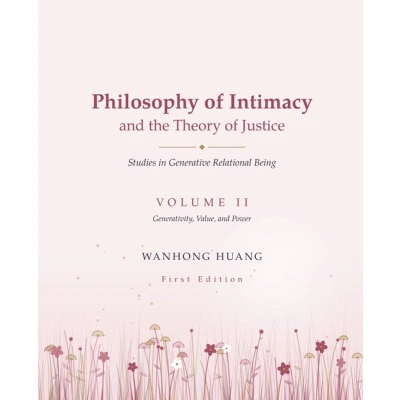
Philosophy of Intimacy and the Theory Justice Studies in Generative Relational Being: Generativity, Value, Power: 2
Uitgelicht

|
39,99 |
Naar shop
|

|
106,99 |
Naar shop
|

|
106,99 |
Naar shop
|
| VERGELIJK ALLE AANBIEDERS (3) | ||
 Beschrijving
Bol
Philosophy of Intimacy and the Theory of Justice is a series of philosophical studies that take intimate life as the place where the question of justice is raised first, and raised most sharply. Its working conviction is that how we treat those closest to us is our most honest answer to the question of justice. Drawing on political economy, ethics and jurisprudence, relational ontology, Lacanian psychoanalysis, developmental psychology and neuroscience, feminist theory, and the formal sciences, the series builds an integrative account of how two subjects constitute one another, generate value between them, and owe one another justice.Volume II, Generativity, Value, and Power, turns from foundations to the economy and politics of the intimate bond. Its central questions are where value comes from in a relationship, whether it returns to those who create it, and what becomes of love when it is crossed by power. Across nine studies it develops a political economy of intimate life.It traces how shared value first arises in joint attention and is carried in language. It reconstructs a just eudaimonia, the good relation understood as a cycle that must return its surplus to both parties rather than draining one to sustain the other. It examines the "sweet cycle" of indulgence and consumption, and asks when such a cycle is genuinely good and when it is a closure that feeds on what lies outside it. It gives a causal account of the non-binding vow, the promise that generates trust and expectation without any power to enforce it. It reconstructs happiness under contingency and mutual becoming. It proposes a theory of generative relational wealth, a good owned by the "between" that use augments rather than depletes. It reads the semiotics of luxury as a matter of how deeply an object is coupled to a life. It asks how a generative relation fares under asymmetries of power, and where love ends and the political economy of its conditions begins. And it closes with an account of generative effacement, the quiet injustice by which one party can be worn away not through domination but through devotion.The volume is written for readers in philosophy, political economy, ethics, and the theory of justice, and for anyone who wishes to think carefully about value, power, and care in intimate life. It is the second of three volumes. Readers are invited to read, contest, continue, and rewrite.


 Beschrijving
(1)
Beschrijving
(1)
Philosophy of Intimacy and the Theory of Justice is a series of philosophical studies that take intimate life as the place where the question of justice is raised first, and raised most sharply. Its working conviction is that how we treat those closest to us is our most honest answer to the question of justice. Drawing on political economy, ethics and jurisprudence, relational ontology, Lacanian psychoanalysis, developmental psychology and neuroscience, feminist theory, and the formal sciences, the series builds an integrative account of how two subjects constitute one another, generate value between them, and owe one another justice.Volume II, Generativity, Value, and Power, turns from foundations to the economy and politics of the intimate bond. Its central questions are where value comes from in a relationship, whether it returns to those who create it, and what becomes of love when it is crossed by power. Across nine studies it develops a political economy of intimate life.It traces how shared value first arises in joint attention and is carried in language. It reconstructs a just eudaimonia, the good relation understood as a cycle that must return its surplus to both parties rather than draining one to sustain the other. It examines the "sweet cycle" of indulgence and consumption, and asks when such a cycle is genuinely good and when it is a closure that feeds on what lies outside it. It gives a causal account of the non-binding vow, the promise that generates trust and expectation without any power to enforce it. It reconstructs happiness under contingency and mutual becoming. It proposes a theory of generative relational wealth, a good owned by the "between" that use augments rather than depletes. It reads the semiotics of luxury as a matter of how deeply an object is coupled to a life. It asks how a generative relation fares under asymmetries of power, and where love ends and the political economy of its conditions begins. And it closes with an account of generative effacement, the quiet injustice by which one party can be worn away not through domination but through devotion.The volume is written for readers in philosophy, political economy, ethics, and the theory of justice, and for anyone who wishes to think carefully about value, power, and care in intimate life. It is the second of three volumes. Readers are invited to read, contest, continue, and rewrite.
 Productspecificaties
 Prijshistorie
* Prijshistorie bevat geen data van Amazon, Amazon Marketplace.
Prijzen voor het laatst bijgewerkt op:
 Gerelateerde resultaten


