
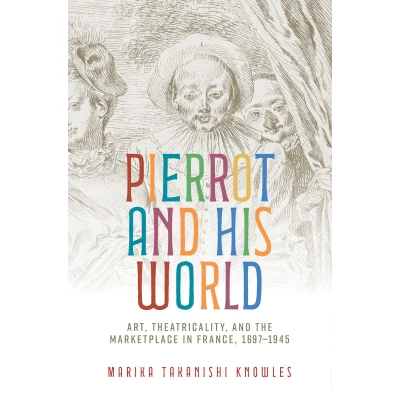
Pierrot and His World
Uitgelicht

|
28,99 |
Naar shop
|

|
32,43 |
Naar shop
|
| VERGELIJK ALLE AANBIEDERS (2) | ||
 Beschrijving
Bol
The stock theatrical character Pierrot is an enduring figure in French visual art, where he emerges at the intersection of theatricality and the marketplace. This book offers an account of Pierrot’s recurrence in painting, prints, photography and film, tracing this distinctive type from the art of Watteau to the cinema of Occupied France. Pierrot, a theatrical stock character known by his distinctive costume of loose white tunic and trousers, is a ubiquitous figure in French art and culture. From monumental paintings to inexpensive tableware, from street theatre to prestige cinema, Pierrot recurs in diverse media through the eighteenth, nineteenth, and twentieth centuries.Moving between historical marketplaces and theatrical repertoires, Pierrot and his world traces the career of this naïve buffoon from the art of Antoine Watteau to the cinema of Occupied France. Pierrot first draws attention to himself on the stages of the eighteenth-century Parisian fairs. Chosen by Watteau to play a key role in the artist’s fêtes galantes, Pierrot then features in the consumable forms of the Rococo style.In the early nineteenth century, Watteau’s large painting Pierrot is discovered at a bric-a-brac shop, a location reflecting the unique character of the post-Revolutionary marketplace. Fifty years later, Edouard Manet nods to this tale of Pierrot’s discovery in his painting The Old Musician (1862). While Manet looked backwards, the photographer Nadar and his brother Adrien Tournachon launched a futuristic Pierrot in photographs displayed at the Exposition Universelle in 1855. Nearly a century later, in Children of Paradise (1945), the ambivalent masterpiece of Occupation cinema, Pierrot is victimized by the ghost of an old-clothes seller.In vivid prose, this richly illustrated book locates Pierrot’s enduring appeal in the frankness of his address to the viewer, whose attention he hails in the marketplace. Pierrot, a theatrical stock character known by his distinctive costume of loose white tunic and trousers, is a ubiquitous figure in French art and culture. This richly illustrated book offers an account of Pierrot’s recurrence in painting, printmaking, photography and film, tracing this distinctive type from the art of Antoine Watteau to the cinema of Occupied France. As a visual type, Pierrot thrives at the intersection of theatrical and marketplace practices. From Watteau’s Pierrot ( c. 1720) and Édouard Manet’s The Old Musician (1862) to Nadar and Adrien Tournachon’s Pierrot the Photographer (1855) and the landmark film Children of Paradise (1945), Pierrot has given artists a medium through which to explore the marketplace as a form for both social life and creative practice. Simultaneously a human figure and a theatrical mask, Pierrot elicits artistic reflection on the representation of personality in the marketplace.


 Beschrijving
(1)
Beschrijving
(1)
The stock theatrical character Pierrot is an enduring figure in French visual art, where he emerges at the intersection of theatricality and the marketplace. This book offers an account of Pierrot’s recurrence in painting, prints, photography and film, tracing this distinctive type from the art of Watteau to the cinema of Occupied France. Pierrot, a theatrical stock character known by his distinctive costume of loose white tunic and trousers, is a ubiquitous figure in French art and culture. From monumental paintings to inexpensive tableware, from street theatre to prestige cinema, Pierrot recurs in diverse media through the eighteenth, nineteenth, and twentieth centuries.Moving between historical marketplaces and theatrical repertoires, Pierrot and his world traces the career of this naïve buffoon from the art of Antoine Watteau to the cinema of Occupied France. Pierrot first draws attention to himself on the stages of the eighteenth-century Parisian fairs. Chosen by Watteau to play a key role in the artist’s fêtes galantes, Pierrot then features in the consumable forms of the Rococo style.In the early nineteenth century, Watteau’s large painting Pierrot is discovered at a bric-a-brac shop, a location reflecting the unique character of the post-Revolutionary marketplace. Fifty years later, Edouard Manet nods to this tale of Pierrot’s discovery in his painting The Old Musician (1862). While Manet looked backwards, the photographer Nadar and his brother Adrien Tournachon launched a futuristic Pierrot in photographs displayed at the Exposition Universelle in 1855. Nearly a century later, in Children of Paradise (1945), the ambivalent masterpiece of Occupation cinema, Pierrot is victimized by the ghost of an old-clothes seller.In vivid prose, this richly illustrated book locates Pierrot’s enduring appeal in the frankness of his address to the viewer, whose attention he hails in the marketplace. Pierrot, a theatrical stock character known by his distinctive costume of loose white tunic and trousers, is a ubiquitous figure in French art and culture. This richly illustrated book offers an account of Pierrot’s recurrence in painting, printmaking, photography and film, tracing this distinctive type from the art of Antoine Watteau to the cinema of Occupied France. As a visual type, Pierrot thrives at the intersection of theatrical and marketplace practices. From Watteau’s Pierrot ( c. 1720) and Édouard Manet’s The Old Musician (1862) to Nadar and Adrien Tournachon’s Pierrot the Photographer (1855) and the landmark film Children of Paradise (1945), Pierrot has given artists a medium through which to explore the marketplace as a form for both social life and creative practice. Simultaneously a human figure and a theatrical mask, Pierrot elicits artistic reflection on the representation of personality in the marketplace.
 Productspecificaties
 Prijshistorie
* Prijshistorie bevat geen data van Amazon.
Prijzen voor het laatst bijgewerkt op:
 Gerelateerde resultaten


