
PIGMENTS and EXTENDERS What They Are Do: Paint Formulation for Beginners — Book 4
Uitgelicht

|
12,22 |
Naar shop
|

|
12,22 |
Naar shop
|

|
12,50 |
Naar shop
|
| VERGELIJK ALLE AANBIEDERS (3) | ||
 Beschrijving
Bol
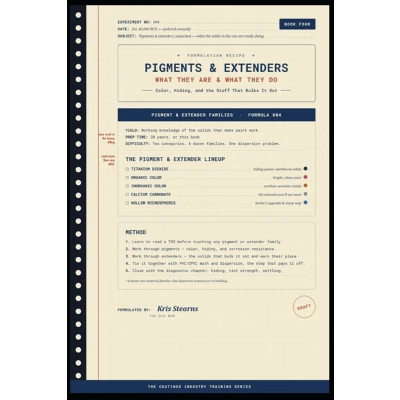
If you've made it this far in the series, you already know the basic idea: paint is not magic, it's a recipe. Book 1 got you comfortable with the industry and the basic chemistry. Book 2 walked you through the five raw material categories - binders, pigments, extenders, solvents, and additives - at the "here's what this does" level. Book 3 took resins apart family by family, because the resin is the piece doing the actual film-forming work, and it deserved the deep dive. This book does the same thing for pigments and extenders. Here's why that matters more than it sounds like it should. A lot of new techs treat pigments and extenders as the boring part of the formula - the stuff that gives the can its color and bulks it out so it doesn't cost a fortune. That's not wrong, exactly. It's just incomplete enough to get you in trouble. Pigments and extenders are the reason a coating hides what's underneath it, holds its color in the sun, resists rust, feels a certain way going on, and costs what it costs. Get the resin right and the paint right and the pigment package wrong, and you'll still end up with a customer complaint. Hiding power, tint strength, gloss, corrosion resistance, sag resistance, cost - most of that traces back to what solid particles you put in the can and how well you got them to spread out evenly instead of clumping together.


 Beschrijving
(1)
Beschrijving
(1)
If you've made it this far in the series, you already know the basic idea: paint is not magic, it's a recipe. Book 1 got you comfortable with the industry and the basic chemistry. Book 2 walked you through the five raw material categories - binders, pigments, extenders, solvents, and additives - at the "here's what this does" level. Book 3 took resins apart family by family, because the resin is the piece doing the actual film-forming work, and it deserved the deep dive. This book does the same thing for pigments and extenders. Here's why that matters more than it sounds like it should. A lot of new techs treat pigments and extenders as the boring part of the formula - the stuff that gives the can its color and bulks it out so it doesn't cost a fortune. That's not wrong, exactly. It's just incomplete enough to get you in trouble. Pigments and extenders are the reason a coating hides what's underneath it, holds its color in the sun, resists rust, feels a certain way going on, and costs what it costs. Get the resin right and the paint right and the pigment package wrong, and you'll still end up with a customer complaint. Hiding power, tint strength, gloss, corrosion resistance, sag resistance, cost - most of that traces back to what solid particles you put in the can and how well you got them to spread out evenly instead of clumping together.
 Productspecificaties
 Prijshistorie
* Prijshistorie bevat geen data van Amazon, Amazon Marketplace.
Prijzen voor het laatst bijgewerkt op:
 Gerelateerde resultaten


