








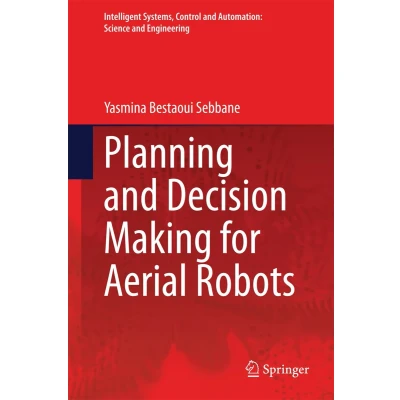
Planning and Decision Making for Aerial Robots: 71
Uitgelicht

|
99,99 |
Naar shop
|

|
106,56 |
Naar shop
|

|
106,56 |
Naar shop
|
 Beschrijving
Bol
Planning and Decision Making for Aerial Robots This book provides an introduction to the emerging field of planning and decision making for aerial robots. An aerial robot is the ultimate form of Unmanned Aerial Vehicle, an aircraft endowed with built-in intelligence, requiring no direct human control and able to perform a specific task. It must be able to fly within a partially structured environment, to react and adapt to changing environmental conditions and to accommodate for the uncertainty that exists in the physical world. An aerial robot can be termed as a physical agent that exists and flies in the real 3D world, can sense its environment and act on it to achieve specific goals. So throughout this book, an aerial robot will also be termed as an agent. Fundamental problems in aerial robotics include the tasks of spatial motion, spatial sensing and spatial reasoning. Reasoning in complex environments represents a difficult problem. The issues specific to spatial reasoning are planning and decision making. Planning deals with the trajectory algorithmic development based on the available information, while decision making determines priorities and evaluates potential environmental uncertainties. The issues specific to planning and decision making for aerial robots in their environment are examined in this book and categorized as follows: motion planning, deterministic decision making, decision making under uncertainty, and finally multi-robot planning. A variety of techniques are presented in this book, and a number of relevant case studies are examined. The topics considered in this book are multidisciplinary in nature and lie at the intersection of Robotics, Control Theory, Operational Research and Artificial Intelligence. This book provides an introduction to the emerging field of planning and decision making for aerial robots. An aerial robot is the ultimate form of Unmanned Aerial Vehicle, an aircraft endowed with built-in intelligence, requiring no direct human control and able to perform a specific task. It must be able to fly within a partially structured environment, to react and adapt to changing environmental conditions and to accommodate for the uncertainty that exists in the physical world. An aerial robot can be termed as a physical agent that exists and flies in the real 3D world, can sense its environment and act on it to achieve specific goals. So throughout this book, an aerial robot will also be termed as an agent. Fundamental problems in aerial robotics include the tasks of spatial motion, spatial sensing and spatial reasoning. Reasoning in complex environments represents a difficult problem. The issues specific to spatial reasoning are planning and decision making. Planning deals with the trajectory algorithmic development based on the available information, while decision making determines priorities and evaluates potential environmental uncertainties. The issues specific to planning and decision making for aerial robots in their environment are examined in this book and categorized as follows: motion planning, deterministic decision making, decision making under uncertainty and finally multi-robot planning. A variety of techniques are presented in this book, and a number of relevant case studies are examined. The topics considered in this book are multidisciplinary in nature and lie at the intersection of Robotics, Control Theory, Operational Research and Artificial Intelligence.


 Beschrijving
(2)
Beschrijving
(2)
Planning and Decision Making for Aerial Robots This book provides an introduction to the emerging field of planning and decision making for aerial robots. An aerial robot is the ultimate form of Unmanned Aerial Vehicle, an aircraft endowed with built-in intelligence, requiring no direct human control and able to perform a specific task. It must be able to fly within a partially structured environment, to react and adapt to changing environmental conditions and to accommodate for the uncertainty that exists in the physical world. An aerial robot can be termed as a physical agent that exists and flies in the real 3D world, can sense its environment and act on it to achieve specific goals. So throughout this book, an aerial robot will also be termed as an agent. Fundamental problems in aerial robotics include the tasks of spatial motion, spatial sensing and spatial reasoning. Reasoning in complex environments represents a difficult problem. The issues specific to spatial reasoning are planning and decision making. Planning deals with the trajectory algorithmic development based on the available information, while decision making determines priorities and evaluates potential environmental uncertainties. The issues specific to planning and decision making for aerial robots in their environment are examined in this book and categorized as follows: motion planning, deterministic decision making, decision making under uncertainty, and finally multi-robot planning. A variety of techniques are presented in this book, and a number of relevant case studies are examined. The topics considered in this book are multidisciplinary in nature and lie at the intersection of Robotics, Control Theory, Operational Research and Artificial Intelligence. This book provides an introduction to the emerging field of planning and decision making for aerial robots. An aerial robot is the ultimate form of Unmanned Aerial Vehicle, an aircraft endowed with built-in intelligence, requiring no direct human control and able to perform a specific task. It must be able to fly within a partially structured environment, to react and adapt to changing environmental conditions and to accommodate for the uncertainty that exists in the physical world. An aerial robot can be termed as a physical agent that exists and flies in the real 3D world, can sense its environment and act on it to achieve specific goals. So throughout this book, an aerial robot will also be termed as an agent. Fundamental problems in aerial robotics include the tasks of spatial motion, spatial sensing and spatial reasoning. Reasoning in complex environments represents a difficult problem. The issues specific to spatial reasoning are planning and decision making. Planning deals with the trajectory algorithmic development based on the available information, while decision making determines priorities and evaluates potential environmental uncertainties. The issues specific to planning and decision making for aerial robots in their environment are examined in this book and categorized as follows: motion planning, deterministic decision making, decision making under uncertainty and finally multi-robot planning. A variety of techniques are presented in this book, and a number of relevant case studies are examined. The topics considered in this book are multidisciplinary in nature and lie at the intersection of Robotics, Control Theory, Operational Research and Artificial Intelligence.
AmazonPagina's: 426, Editie: 2014, Hardcover, Springer
 Productspecificaties
 Prijshistorie
* Prijshistorie bevat geen data van Amazon, Amazon Marketplace.
Prijzen voor het laatst bijgewerkt op:
 Gerelateerde resultaten


