
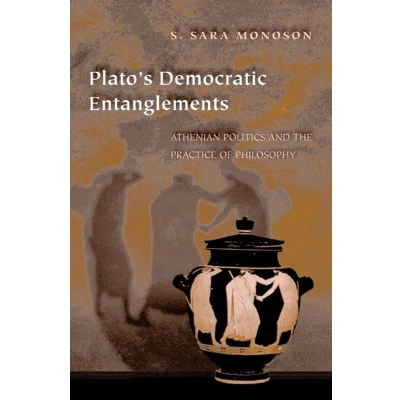
Plato`s Democratic Entanglements Athenian Politics and the Practice of Philosophy
Uitgelicht

|
95,91 |
Naar shop
|
| VERGELIJK ALLE AANBIEDERS (1) | ||
 Beschrijving
Bol Partner
Challenges the view that Plato is a virulent opponent of all things democratic. This book argues that we should attend more closely to Plato's suggestion that democracy is horrifying and exciting, and seeks to explain why he found it morally and politically intriguing. In this book, Sara Monoson challenges the longstanding and widely held view that Plato is a virulent opponent of all things democratic. She does not, however, offer in its place the equally mistaken idea that he is somehow a partisan of democracy. Instead, she argues that we should attend more closely to Plato's suggestion that democracy is horrifying and exciting, and she seeks to explain why he found it morally and politically intriguing. Monoson focuses on Plato's engagement with democracy as he knew it: a cluster of cultural practices that reach into private and public life, as well as a set of governing institutions. She proposes that while Plato charts tensions between the claims of democratic legitimacy and philosophical truth, he also exhibits a striking attraction to four practices central to Athenian democratic politics: intense antityrantism, frank speaking, public funeral oratory, and theater-going. By juxtaposing detailed examination of these aspects of Athenian democracy with analysis of the figurative language, dramatic structure, and arguments of the dialogues, she shows that Plato systematically links democratic ideals and activities to philosophic labor. Monoson finds that Plato's political thought exposes intimate connections between Athenian democratic politics and the practice of philosophy. Situating Plato's political thought in the context of the Athenian democratic imaginary, Monoson develops a new, textured way of thinking of the relationship between Plato's thought and the politics of his city.


Vergelijk aanbieders (1)

 Beschrijving
(1)
Beschrijving
(1)
Challenges the view that Plato is a virulent opponent of all things democratic. This book argues that we should attend more closely to Plato's suggestion that democracy is horrifying and exciting, and seeks to explain why he found it morally and politically intriguing. In this book, Sara Monoson challenges the longstanding and widely held view that Plato is a virulent opponent of all things democratic. She does not, however, offer in its place the equally mistaken idea that he is somehow a partisan of democracy. Instead, she argues that we should attend more closely to Plato's suggestion that democracy is horrifying and exciting, and she seeks to explain why he found it morally and politically intriguing. Monoson focuses on Plato's engagement with democracy as he knew it: a cluster of cultural practices that reach into private and public life, as well as a set of governing institutions. She proposes that while Plato charts tensions between the claims of democratic legitimacy and philosophical truth, he also exhibits a striking attraction to four practices central to Athenian democratic politics: intense antityrantism, frank speaking, public funeral oratory, and theater-going. By juxtaposing detailed examination of these aspects of Athenian democracy with analysis of the figurative language, dramatic structure, and arguments of the dialogues, she shows that Plato systematically links democratic ideals and activities to philosophic labor. Monoson finds that Plato's political thought exposes intimate connections between Athenian democratic politics and the practice of philosophy. Situating Plato's political thought in the context of the Athenian democratic imaginary, Monoson develops a new, textured way of thinking of the relationship between Plato's thought and the politics of his city.
 Productspecificaties
| EAN |
|
|---|---|
| Maat |
|
 Prijshistorie
Prijzen voor het laatst bijgewerkt op:
 Gerelateerde resultaten


