


€ 34,99 Gratis verzending

Uitgelicht
|
|
34,99 |
Naar shop
|

|
36,89 |
Naar shop
|

|
36,89 |
Naar shop
|
| VERGELIJK ALLE AANBIEDERS (3) | ||
 Beschrijving
Vergelijk aanbieders (3)
€ 34,99 Gratis verzending
€ 36,89 Gratis verzending
€ 36,89 Gratis verzending
Winkels met andere maten
Beschrijving
(1)
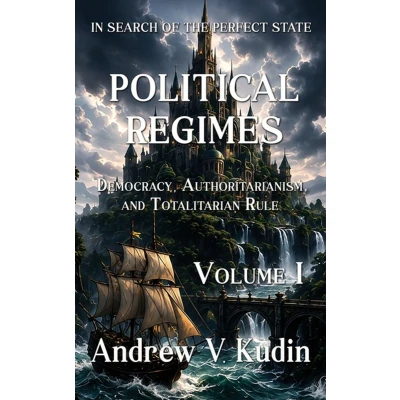
Power no longer needs to announce itself. It adapts.Political Regimes, Volume I examines how modern political power is organized, justified, experienced, and endured. Moving beyond formal constitutional labels, Andrew V. Kudin studies regimes through the lived pressure they place on human beings: the fear of speaking, the cost of dissent, the seduction of order, the burden of freedom, and the gradual transformation of citizens into spectators, subjects, or believers.This volume covers democratic and authoritarian forms of rule. Its first part analyzes direct, representative, liberal, electoral, and illiberal democracy, tracing both the promise of political freedom and the institutional fragility that allows participation to decay into performance. Its second part turns to authoritarian regimes - military, personalist, bureaucratic, electoral, and party-based - and examines how obedience is normalized, opposition is contained, and power learns to preserve the appearance of legality while narrowing the space of political life.Grounded in political theory and vivid historical cases, from ancient Athens and postwar Germany to Pinochet's Chile, Franco's Spain, and Chávez's Venezuela, the book joins institutional analysis with a psychological reading of fear, conformity, loyalty, loneliness, and the human desire to belong to something stronger than oneself.Political Regimes, Volume I is written for readers of political philosophy, comparative politics, history, civic education, and anyone seeking to understand how freedom is weakened not only by open violence, but by procedure, fatigue, compromise, and the reasonable concessions by which societies slowly surrender the power to govern themselves.This first volume examines democratic and authoritarian regimes. Volume II continues the inquiry with totalitarian, transitional, and hybrid forms of rule.
 Prijshistorie
 * Prijshistorie bevat geen data van Amazon, Amazon Marketplace.
Prijzen voor het laatst bijgewerkt op:
 Gerelateerde resultaten
 Productspecificaties


