








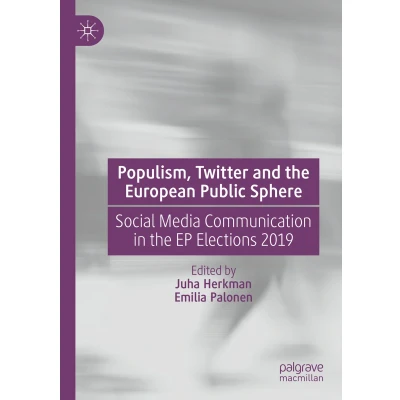
Populism, Twitter and the European Public Sphere
Uitgelicht

|
114,99 |
Naar shop
|

|
114,99 |
Naar shop
|

|
128,39 |
Naar shop
|
 Beschrijving
Bol
This volume approaches the relationship between European public sphere and political communication in the framework of establishing populism and social media. The empirical analysis focuses on the comparison between different EU countries during the 2019 EP elections campaign. The data for the analysis was collected real time from Twitter in the Netherlands, Germany, Finland, Italy, Spain, Ireland and the UK. during a month period and are analyzed with both computerized quantitative and manual qualitative methods. The book introduces a new perspective in conceptualizing populism in comparative analysis, in which populism is understood rather as an antagonist logic of political identity formation than pre-defined political ideologies, movements or party cleavages. We approach implications of populist construction of ‘us’ and ‘not us’ in national contexts of 2019 EP election campaigns to find out the relationality between different political actors and parties. A special attention is paid to national/transnational and European/Eurosceptic tendencies in campaign rhetoric. By using a unique idea of ‘hashtag publics’ we approach the common Twitter discussions around the elections and ask: what particular topics and themes did different political actors distribute over Twitter during the 2019 EP elections, how were various topics and actors linked to each other, and how were campaign agendas and actors linked to populism? Juha Herkman is an Associate Professor of Media and Communication Studies at the University of Helsinki, Finland. Emilia Palonen works as a Senior University Lecturer in Political Science at the University of Helsinki. Chapter-No.1,Chapter-No.4 and Chapter-No. 8 are available open access under a Creative Commons Attribution 4.0 International License via link.springer.com. This volume approaches the relationship between European public sphere and political communication in the framework of establishing populism and social media. The empirical analysis focuses on the comparison between different EU countries during the 2019 EP elections campaign. The data for the analysis was collected real time from Twitter in the Netherlands, Germany, Finland, Italy, Spain, Ireland and the UK. during a month period and are analyzed with both computerized quantitative and manual qualitative methods. The book introduces a new perspective in conceptualizing populism in comparative analysis, in which populism is understood rather as an antagonist logic of political identity formation than pre-defined political ideologies, movements or party cleavages. We approach implications of populist construction of ‘us’ and ‘not us’ in national contexts of 2019 EP election campaigns to find out the relationality between different political actors and parties. A special attention is paid to national/transnational and European/Eurosceptic tendencies in campaign rhetoric. By using a unique idea of ‘hashtag publics’ we approach the common Twitter discussions around the elections and ask: what particular topics and themes did different political actors distribute over Twitter during the 2019 EP elections, how were various topics and actors linked to each other, and how were campaign agendas and actors linked to populism? Chapter-No.1,Chapter-No.4 and Chapter-No. 8 are available open access under a Creative Commons Attribution 4.0 International License via link.springer.com.


 Beschrijving
(2)
Beschrijving
(2)
This volume approaches the relationship between European public sphere and political communication in the framework of establishing populism and social media. The empirical analysis focuses on the comparison between different EU countries during the 2019 EP elections campaign. The data for the analysis was collected real time from Twitter in the Netherlands, Germany, Finland, Italy, Spain, Ireland and the UK. during a month period and are analyzed with both computerized quantitative and manual qualitative methods. The book introduces a new perspective in conceptualizing populism in comparative analysis, in which populism is understood rather as an antagonist logic of political identity formation than pre-defined political ideologies, movements or party cleavages. We approach implications of populist construction of ‘us’ and ‘not us’ in national contexts of 2019 EP election campaigns to find out the relationality between different political actors and parties. A special attention is paid to national/transnational and European/Eurosceptic tendencies in campaign rhetoric. By using a unique idea of ‘hashtag publics’ we approach the common Twitter discussions around the elections and ask: what particular topics and themes did different political actors distribute over Twitter during the 2019 EP elections, how were various topics and actors linked to each other, and how were campaign agendas and actors linked to populism? Juha Herkman is an Associate Professor of Media and Communication Studies at the University of Helsinki, Finland. Emilia Palonen works as a Senior University Lecturer in Political Science at the University of Helsinki. Chapter-No.1,Chapter-No.4 and Chapter-No. 8 are available open access under a Creative Commons Attribution 4.0 International License via link.springer.com. This volume approaches the relationship between European public sphere and political communication in the framework of establishing populism and social media. The empirical analysis focuses on the comparison between different EU countries during the 2019 EP elections campaign. The data for the analysis was collected real time from Twitter in the Netherlands, Germany, Finland, Italy, Spain, Ireland and the UK. during a month period and are analyzed with both computerized quantitative and manual qualitative methods. The book introduces a new perspective in conceptualizing populism in comparative analysis, in which populism is understood rather as an antagonist logic of political identity formation than pre-defined political ideologies, movements or party cleavages. We approach implications of populist construction of ‘us’ and ‘not us’ in national contexts of 2019 EP election campaigns to find out the relationality between different political actors and parties. A special attention is paid to national/transnational and European/Eurosceptic tendencies in campaign rhetoric. By using a unique idea of ‘hashtag publics’ we approach the common Twitter discussions around the elections and ask: what particular topics and themes did different political actors distribute over Twitter during the 2019 EP elections, how were various topics and actors linked to each other, and how were campaign agendas and actors linked to populism? Chapter-No.1,Chapter-No.4 and Chapter-No. 8 are available open access under a Creative Commons Attribution 4.0 International License via link.springer.com.
AmazonPagina's: 297, Paperback, Palgrave Macmillan
 Productspecificaties
 Prijshistorie
* Prijshistorie bevat geen data van Amazon, Amazon Marketplace.
Prijzen voor het laatst bijgewerkt op:
 Gerelateerde resultaten


