
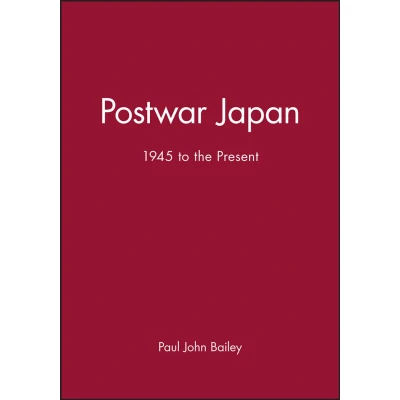
Postwar Japan
Uitgelicht

|
50,99 |
Naar shop
|
| VERGELIJK ALLE AANBIEDERS (1) | ||
 Beschrijving
Bol
aeo Provides a much--needed, accessible overview of the Japanese economic miracle. aeo Sets economic discussions against clear political and social background. aeo Draws on recent research to reexamine complex relationship with the US. Within forty years of the end of the Second World War, Japan was transformed from a nation in defeat to one of the most successful economic forces in the world. In this book, Paul Bailey draws on the most recent research to analyze the significance of the American Occupation (1945-52) as well as the later political, social and economic factors that contributed to postwar recovery. Challenging the usual image of Japan as a country of stability and consensus during this period, the author focuses attention on internal tensions, including political conflict and citizen protest. He discusses, for instance, the opposition to the ruling conservative party's attempts to roll back the occupation reforms, the anti-pollution and anti-Vietnam War movements, and the achievement of electoral success by the left-wing opposition at local government level. He also examines foreign policy, explaining, in particular, Japan's ambivalent relationship with the United States and the growing importance of Sino-Japanese relations. Finally, the book assesses the reasons for the hegemony of the ruling conservative Liberal-Democratic Party in the postwar period, and how it unravelled in the early 1990s. Within forty years of the end of the Second World War, Japan was transformed from a nation in defeat to one of the most successful economic forces in the world. In this book, Paul Bailey draws on the most recent research to analyse the significance of the American Occupation (1945-52) as well as the later political, social and economic factors that contributed to postwar recovery.


Vergelijk aanbieders (1)

 Beschrijving
(1)
Beschrijving
(1)
aeo Provides a much--needed, accessible overview of the Japanese economic miracle. aeo Sets economic discussions against clear political and social background. aeo Draws on recent research to reexamine complex relationship with the US. Within forty years of the end of the Second World War, Japan was transformed from a nation in defeat to one of the most successful economic forces in the world. In this book, Paul Bailey draws on the most recent research to analyze the significance of the American Occupation (1945-52) as well as the later political, social and economic factors that contributed to postwar recovery. Challenging the usual image of Japan as a country of stability and consensus during this period, the author focuses attention on internal tensions, including political conflict and citizen protest. He discusses, for instance, the opposition to the ruling conservative party's attempts to roll back the occupation reforms, the anti-pollution and anti-Vietnam War movements, and the achievement of electoral success by the left-wing opposition at local government level. He also examines foreign policy, explaining, in particular, Japan's ambivalent relationship with the United States and the growing importance of Sino-Japanese relations. Finally, the book assesses the reasons for the hegemony of the ruling conservative Liberal-Democratic Party in the postwar period, and how it unravelled in the early 1990s. Within forty years of the end of the Second World War, Japan was transformed from a nation in defeat to one of the most successful economic forces in the world. In this book, Paul Bailey draws on the most recent research to analyse the significance of the American Occupation (1945-52) as well as the later political, social and economic factors that contributed to postwar recovery.
 Productspecificaties
| EAN |
|
|---|---|
| Maat |
|
 Prijshistorie
Prijzen voor het laatst bijgewerkt op:
 Gerelateerde resultaten


