
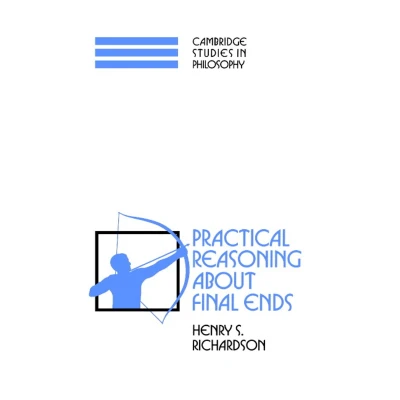
Practical Reasoning About Final Ends
Uitgelicht

|
48,60 |
Naar shop
|

|
48,60 |
Naar shop
|

|
52,99 |
Naar shop
|
| VERGELIJK ALLE AANBIEDERS (3) | ||
 Beschrijving
Bol
Henry Richardson argues that we can determine our ends rationally. He constructs a theory of how we can reason about what to seek for its own sake as a final goal. Richardson develops ideas about how his model might be extended to interpersonal deliberation of ends. Henry Richardson argues that we can determine our ends rationally. He constructs a rich and original theory of how we can reason about our final goals. Richardson defuses the counter-arguments for the limits of rational deliberation, and develops interesting ideas about how his model might be extended to interpersonal deliberation of ends, taking him to the borders of political theory. Along the way Richardson offers illuminating discussions of, inter alia, Aristotle, Aquinas, Sidgwick, and Dewey, as well as the work of several contemporary philosophers.


 Beschrijving
(1)
Beschrijving
(1)
Henry Richardson argues that we can determine our ends rationally. He constructs a theory of how we can reason about what to seek for its own sake as a final goal. Richardson develops ideas about how his model might be extended to interpersonal deliberation of ends. Henry Richardson argues that we can determine our ends rationally. He constructs a rich and original theory of how we can reason about our final goals. Richardson defuses the counter-arguments for the limits of rational deliberation, and develops interesting ideas about how his model might be extended to interpersonal deliberation of ends, taking him to the borders of political theory. Along the way Richardson offers illuminating discussions of, inter alia, Aristotle, Aquinas, Sidgwick, and Dewey, as well as the work of several contemporary philosophers.
 Productspecificaties
 Prijshistorie
* Prijshistorie bevat geen data van Amazon, Amazon Marketplace.
Prijzen voor het laatst bijgewerkt op:
 Gerelateerde resultaten


