

€ 37,26 Gratis verzending

Uitgelicht
|
|
37,26 |
Naar shop
|

|
37,26 |
Naar shop
|

|
37,99 |
Naar shop
|
| VERGELIJK ALLE AANBIEDERS (3) | ||
 Beschrijving
Vergelijk aanbieders (3)
€ 37,26 Gratis verzending
€ 37,26 Gratis verzending
€ 37,99 Gratis verzending
Winkels met andere maten
Beschrijving
(1)
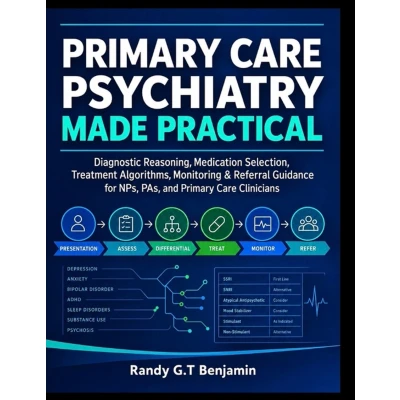
A patient comes in for insomnia. >In primary care, psychiatric problems rarely arrive with a neat psychiatric label. Primary Care Psychiatry Made Practical is designed for clinicians who need a practical framework for recognizing common psychiatric presentations, working through the differential diagnosis, selecting appropriate treatment strategies, monitoring response, and knowing when specialist referral is necessary. This is not a traditional psychiatry textbook built around memorizing disorder descriptions. It is organized around the clinical decisions primary care clinicians face every day. Inside, you will learn how to: - Approach common psychiatric presentations using structured diagnostic reasoning - Build a focused psychiatric differential diagnosis in primary care - Recognize important medical, medication-related, and substance-related contributors to psychiatric symptoms - Select appropriate psychotropic medication strategies based on the clinical presentation - Understand treatment algorithms for common mood, anxiety, psychotic, attention-related, sleep, and substance-related conditions - Monitor therapeutic response, adverse effects, and clinically important changes during treatment - Recognize psychiatric red flags that require urgent evaluation or escalation of care - Determine when a condition can be managed in primary care and when psychiatric referral is appropriate >Designed for today's primary care clinician This practical reference is especially useful for nurse practitioners, physician assistants, family medicine clinicians, internal medicine clinicians, and other primary care professionals who encounter behavioral and mental health conditions in routine practice. Rather than asking you to memorize disconnected facts, the book emphasizes a repeatable clinical workflow: Recognize → Assess → Differentiate → Treat → Monitor → Refer Use that framework to approach common psychiatric presentations with greater structure and confidence while staying within the appropriate clinical scope of practice. Practical tools include: - Diagnostic frameworks - Differential-diagnosis tables - Treatment algorithms - Medication-selection considerations - Monitoring checkpoints - Referral indicators - Clinical pearls - Case-based applications If you work in primary care and regularly encounter patients whose physical complaints, behavioral symptoms, medications, and mental health needs overlap, this book is designed to give you a clearer way to think through those encounters. Primary care does not need less psychiatry. It needs psychiatry translated into practical clinical decisions.
 Prijshistorie
 * Prijshistorie bevat geen data van Amazon, Amazon Marketplace.
Prijzen voor het laatst bijgewerkt op:
 Gerelateerde resultaten
 Productspecificaties


