


€ 125,00 Gratis verzending

Uitgelicht
|
|
125,00 |
Naar shop
|
| VERGELIJK ALLE AANBIEDERS (1) | ||
 Beschrijving
Vergelijk aanbieders (1)
€ 125,00 Gratis verzending
Winkels met andere maten
Beschrijving
(1)
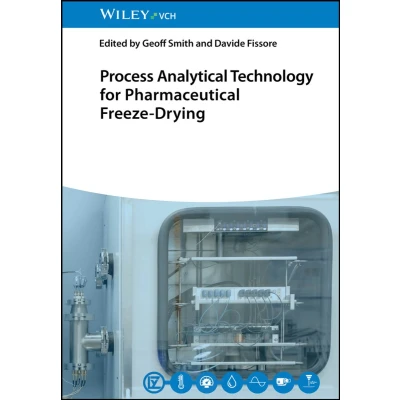
Case studies and insights into an essential pharmaceutical process technology Process Analytical Technology for Pharmaceutical Freeze-Drying delivers a comprehensive and forward-looking examination of monitoring, control, and innovation in one of the pharmaceutical industry’s most technically demanding manufacturing operations. Combining scientific fundamentals with industrial case studies, it bridges theory and real-world practice. The book begins by establishing the scientific and engineering principles of freeze-drying (Chapter 1), covering formulation requirements, process stages, and the thermodynamics governing heat and mass transfer. Core process variables, particularly temperature (Chapter 2) and pressure (Chapter 3), are analysed within a unified framework that reviews established measurement technologies while critically evaluating their performance under manufacturing conditions; with the benefits of wireless sensing strategies being described in Chapter 4. A central focus for the book is advanced and emerging process analytical technologies (PAT). Modern pressure-rise methods (MTM, PRA, DPE) and sublimation-flow analysis are examined in Chapter 5, alongside tunable diode laser absorption spectroscopy (TDLAS). Spectroscopic tools, near-infrared (NIR) and Raman spectroscopy, and their combination with multivariate analysis and model-based control strategies is explored in Chapter 6, demonstrating how enhanced data interpretation enables improved process understanding and optimisation. Another distinctive feature is the in-depth treatment of through-vial impedance spectroscopy (TVIS) in Chapters 7–9, which is presented as a non-invasive, single-vial technology capable of real-time monitoring of product temperature, ice mass, sublimation rate, and phase transitions, including the measurement directly through the vial wall of processes such as ice crystallisation, the glass transition and devitrification. These chapters detail its theoretical foundations, instrumentation design, electrical modelling, multiplexing strategies, and industrial validation, including integration with batch-level measurements to determine true sublimation end points. Infrared thermal imaging is presented in Chapter 10 for both batch and continuous production systems, highlighting applications in parameter estimation and feedback control. Emerging freeze-drying platforms, including spray, spin, suspended-vial, and other continuous approaches, are discussed in Chapter 11 alongside innovations in container design, loading configurations, wireless sensing, and the use of artificial intelligence and machine learning for advanced control and optimisation. And finally, the freezing stage receives dedicated attention in Chapter 12, including discussions of controlled nucleation technologies and their industrial implications. By critically assessing both established and next-generation tools across Chapters 1–12, this book equips scientists and engineers to design robust processes, strengthen control strategies, support scale-up, and ensure consistent product quality. Comprehensive insights into process analytical technology for pharmaceutical freeze-drying Process Analytical Technology for Pharmaceutical Freeze-Drying provides a comprehensive and forward-looking overview of monitoring and control strategies for one of the pharmaceutical industry’s most technically demanding manufacturing processes. Combining scientific fundamentals with industrial case studies, the book examines both established and emerging technologies used to improve process understanding, optimise cycle design, and ensure consistent product quality. Coverage includes the measurement and interpretation of critical process variables such as temperature and pressure, wireless sensing technologies, pressure-rise methods (MTM, PRA, DPE), tunable diode laser absorption spectroscopy (TDLAS), near-infrared (NIR) and Raman spectroscopy, infrared thermal imaging, and advanced data analysis approaches. Dedicated chapters also explore through-vial impedance spectroscopy (TVIS) as a non-invasive technology for real-time monitoring of product temperature, ice mass, sublimation behaviour, and phase transitions. The book further discusses innovations in continuous and alternative freeze-drying platforms, controlled nucleation technologies, multiplexed PAT systems, and the growing role of artificial intelligence and model-based control strategies in pharmaceutical manufacturing. Sample topics explored in Process Analytical Technology for Pharmaceutical Freeze-Drying include: Temperature and pressure measurement technologies and their application to freeze-drying process monitoring and control Wireless sensing approaches for real-time monitoring of pharmaceutical freeze-drying Pressure-rise and sublimation-flow methods for determination of product temperature, sublimation rate, and heat and mass transfer parameters Spectroscopic, impedance-based, and thermal imaging techniques for advanced process analysis and optimisation Emerging freeze-drying technologies, continuous manufacturing approaches, and AI-enabled process control strategies Process Analytical Technology for Pharmaceutical Freeze-Drying is an essential resource for scientists and engineers involved in pharmaceutical freeze-drying, PAT implementation, formulation development, process optimisation, and manufacturing scale-up.
 Productspecificaties
| EAN |
|
|---|---|
| Maat |
|
 Prijshistorie
 Prijzen voor het laatst bijgewerkt op:
 Gerelateerde resultaten


