
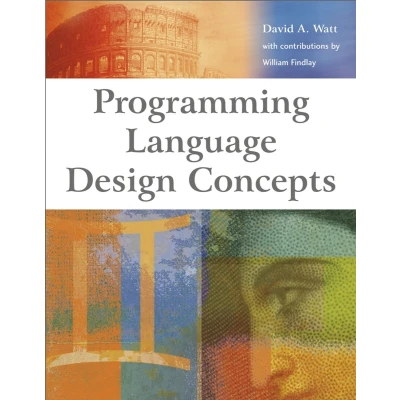
Programming Language Design Concepts
Uitgelicht

|
69,67 |
Naar shop
|

|
75,65 |
Naar shop
|
| VERGELIJK ALLE AANBIEDERS (2) | ||
 Beschrijving
Bol
Explains the concepts underlying programming languages, and demonstrates how these concepts are synthesized in the paradigms: imperative, OO, concurrent, functional, logic and with scripting languages. This book includes numerous examples using C, Java and C++ as exemplar languages. Programming languages exist to communicate with computers and also with people. A good language, like a good mathematical notation, helps us to formulate and communicate ideas more quickly. Yet there are many programming languages and many features to understand in each. Reflecting current trends where object-oriented (OO) programming has taken over from imperative programming as the dominant paradigm, this book gives greatest prominence to the OO paradigm using Java and C++ as the main exemplar languages. Similarly, since the Web has revolutionized the computing industry, the need for examination of scripting languages, such as Perl and Python, has risen. With additional case study languages including Python, Haskell, Prolog and Ada, Programming Language Design Concepts deepens study by examining the motivation of programming languages rather than just their features. ,P.All programmers, not just language specialists, need a thorough understanding of language concepts in order to get the best of these most fundamental tools. This book explains the basic concepts that underpin all programming languages, and shows how these concepts are synthesized in the major paradigms: imperative, object-oriented, concurrent, functional, logic and scripting. Written in a clear, approachable style, ideal for classroom and self-study, the book includes numerous examples, case studies of several major programming languages, and end-of-chapter exercises. Sample solutions to exercises are available on the companion website. Companion website: This book explains the concepts underlying programming languages, and demonstrates how these concepts are synthesized in the major paradigms: imperative, OO, concurrent, functional, logic and scripting. It gives greatest prominence to the OO paradigm, and uses Java as the main exemplar language. It includes numerous examples, case studies of several major programming languages, and numerous end-of-chapter exercises. Sample solutions to most of the exercises are provided at the book’s companion Web site


 Beschrijving
(1)
Beschrijving
(1)
Explains the concepts underlying programming languages, and demonstrates how these concepts are synthesized in the paradigms: imperative, OO, concurrent, functional, logic and with scripting languages. This book includes numerous examples using C, Java and C++ as exemplar languages. Programming languages exist to communicate with computers and also with people. A good language, like a good mathematical notation, helps us to formulate and communicate ideas more quickly. Yet there are many programming languages and many features to understand in each. Reflecting current trends where object-oriented (OO) programming has taken over from imperative programming as the dominant paradigm, this book gives greatest prominence to the OO paradigm using Java and C++ as the main exemplar languages. Similarly, since the Web has revolutionized the computing industry, the need for examination of scripting languages, such as Perl and Python, has risen. With additional case study languages including Python, Haskell, Prolog and Ada, Programming Language Design Concepts deepens study by examining the motivation of programming languages rather than just their features. ,P.All programmers, not just language specialists, need a thorough understanding of language concepts in order to get the best of these most fundamental tools. This book explains the basic concepts that underpin all programming languages, and shows how these concepts are synthesized in the major paradigms: imperative, object-oriented, concurrent, functional, logic and scripting. Written in a clear, approachable style, ideal for classroom and self-study, the book includes numerous examples, case studies of several major programming languages, and end-of-chapter exercises. Sample solutions to exercises are available on the companion website. Companion website: This book explains the concepts underlying programming languages, and demonstrates how these concepts are synthesized in the major paradigms: imperative, OO, concurrent, functional, logic and scripting. It gives greatest prominence to the OO paradigm, and uses Java as the main exemplar language. It includes numerous examples, case studies of several major programming languages, and numerous end-of-chapter exercises. Sample solutions to most of the exercises are provided at the book’s companion Web site
 Productspecificaties
 Prijshistorie
* Prijshistorie bevat geen data van Amazon.
Prijzen voor het laatst bijgewerkt op:
 Gerelateerde resultaten


