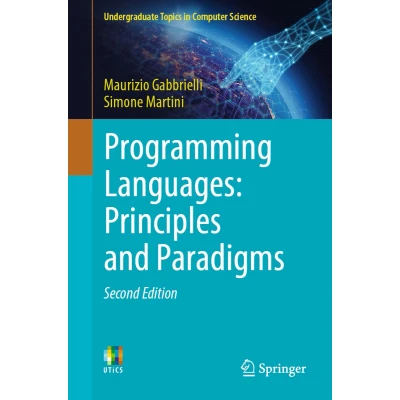

Programming Languages: Principles and Paradigms

Prijzen vanaf
31,73

Uitgelicht

VERGELIJK ALLE AANBIEDERS (2)

Beschrijving

Bol The second edition of this core textbook is a thorough, up-to-date introduction to the principles and techniques that guide the design and implementation of modern programming languages. The goal of the book is to provide the basis for a critical understanding of most modern programming languages. Thus, rather than focusing on a specific language, the book identifies the most important principles shared by large classes of languages. The notion of ‘abstract machine’ is a unifying concept that helps to maintain an accurate and elementary treatment. The book introduces, analyses in depth, and compares the imperative, object-oriented, functional, logic, concurrent, constraint-based, and service-oriented programming paradigms. All material coming from the first English edition has been updated and extended, clarifying some tricky points, and discussing newer programming languages. This second edition contains new chapters dedicated to constraint, concurrent, and service-oriented programming. Topics and features: Requires familiarity with one programming language is a prerequisite Provides a chapter on history offering context for most of the constructs in use today Presents an elementary account of semantical approaches and of computability Introduces new examples in modern programming languages like Python or Scala Offers a chapter that opens a perspective on applications in artificial intelligence Conceived as a university textbook, this unique volume will also be suitable for IT specialists who want to deepen their knowledge of the mechanisms behind the languages they use. The choice of themes and the presentation style are largely influenced by the experience of teaching the content as part of a bachelor's degree in computer science. The authors are all affiliated with the Dept. of Computer Science and Engineering of the University of Bologna. Maurizio Gabbrielli and Simone Martini are professors of computer science, Saverio Giallorenzo is junior assistant professor of computer science. This textbook is a thorough, up-to-date introduction to the principles and techniques that guide the design and implementation of modern programming languages. The goal of the book is to provide the basis for a critical understanding of most modern programming languages. Thus, rather than focusing on a specific language, the book identifies the most important principles shared by large classes of languages. The notion of ‘abstract machine’ is a unifying concept that helps to maintain an accurate and elementary treatment. The book introduces, analyses in depth, and compares the imperative, object-oriented, functional, logic, concurrent, constraint-based, and service-oriented programming paradigms. All material coming from the first English edition has been updated and extended, clarifying some tricky points, and discussing newer programming languages. This second edition contains new chapters dedicated to constraint, concurrent, and service-oriented programming. Topics and features: Requires familiarity with one programming language is a prerequisite Provides a chapter on history offering context for most of the constructs in use today Presents an elementary account of semantical approaches and of computability Introduces new examples in modern programming languages like Python or Scala Offers a chapter that opens a perspective on applications in artificial intelligence Conceived as a university textbook, this unique volume will also be suitable for IT specialists who want to deepen their knowledge of the mechanisms behind the languages they use. The choice of themes and the presentation style are largely influenced by the experience of teaching the content as part of a bachelor's degree in computer science.

Vergelijk aanbieders (2)

Shop
Prijs
Verzendkosten
Totale prijs
31,73
gebruikt
Gratis
31,73
Naar shop
Gratis Shipping Costs
50,99
Gratis
50,99
Naar shop
Gratis Shipping Costs
Beschrijving (2)
Bol

The second edition of this core textbook is a thorough, up-to-date introduction to the principles and techniques that guide the design and implementation of modern programming languages. The goal of the book is to provide the basis for a critical understanding of most modern programming languages. Thus, rather than focusing on a specific language, the book identifies the most important principles shared by large classes of languages. The notion of ‘abstract machine’ is a unifying concept that helps to maintain an accurate and elementary treatment. The book introduces, analyses in depth, and compares the imperative, object-oriented, functional, logic, concurrent, constraint-based, and service-oriented programming paradigms. All material coming from the first English edition has been updated and extended, clarifying some tricky points, and discussing newer programming languages. This second edition contains new chapters dedicated to constraint, concurrent, and service-oriented programming. Topics and features: Requires familiarity with one programming language is a prerequisite Provides a chapter on history offering context for most of the constructs in use today Presents an elementary account of semantical approaches and of computability Introduces new examples in modern programming languages like Python or Scala Offers a chapter that opens a perspective on applications in artificial intelligence Conceived as a university textbook, this unique volume will also be suitable for IT specialists who want to deepen their knowledge of the mechanisms behind the languages they use. The choice of themes and the presentation style are largely influenced by the experience of teaching the content as part of a bachelor's degree in computer science. The authors are all affiliated with the Dept. of Computer Science and Engineering of the University of Bologna. Maurizio Gabbrielli and Simone Martini are professors of computer science, Saverio Giallorenzo is junior assistant professor of computer science. This textbook is a thorough, up-to-date introduction to the principles and techniques that guide the design and implementation of modern programming languages. The goal of the book is to provide the basis for a critical understanding of most modern programming languages. Thus, rather than focusing on a specific language, the book identifies the most important principles shared by large classes of languages. The notion of ‘abstract machine’ is a unifying concept that helps to maintain an accurate and elementary treatment. The book introduces, analyses in depth, and compares the imperative, object-oriented, functional, logic, concurrent, constraint-based, and service-oriented programming paradigms. All material coming from the first English edition has been updated and extended, clarifying some tricky points, and discussing newer programming languages. This second edition contains new chapters dedicated to constraint, concurrent, and service-oriented programming. Topics and features: Requires familiarity with one programming language is a prerequisite Provides a chapter on history offering context for most of the constructs in use today Presents an elementary account of semantical approaches and of computability Introduces new examples in modern programming languages like Python or Scala Offers a chapter that opens a perspective on applications in artificial intelligence Conceived as a university textbook, this unique volume will also be suitable for IT specialists who want to deepen their knowledge of the mechanisms behind the languages they use. The choice of themes and the presentation style are largely influenced by the experience of teaching the content as part of a bachelor's degree in computer science.

Bol Partner

Programming Languages is a self-contained approach to the topic, and differentiates between the design, implementation and pragmatic aspects of programming languages overall. The main programming paradigms are presented, in a straightforward way. This excellent addition to the UTiCS series of undergraduate textbooks provides a detailed and up to date description of the main principles behind the design and implementation of modern programming languages. Rather than focusing on a specific language, the book identifies the most important principles shared by large classes of languages. To complete this general approach, detailed descriptions of the main programming paradigms, namely imperative, object-oriented, functional and logic are given, analysed in depth and compared. This provides the basis for a critical understanding of most of the programming languages. An historical viewpoint is also included, discussing the evolution of programming languages, and to provide a context for most of the constructs in use today. The book concludes with two chapters which introduce basic notions of syntax, semantics and computability, to provide a completely rounded picture of what constitutes a programminglanguage.


Productspecificaties

EAN
  • 9781848829138
  • 9783031341434
Maat


Prijshistorie

Prijzen voor het laatst bijgewerkt op:

Uitgelichte Keuze
31,73
Naar shop
