


€ 215,00 Gratis verzending

Uitgelicht
|
|
215,00 |
Naar shop
|

|
231,90 |
Naar shop
|

|
231,90 |
Naar shop
|
| VERGELIJK ALLE AANBIEDERS (3) | ||
 Beschrijving
Vergelijk aanbieders (3)
€ 215,00 Gratis verzending
€ 231,90 Gratis verzending
€ 231,90 Gratis verzending
Winkels met andere maten
Beschrijving
(1)
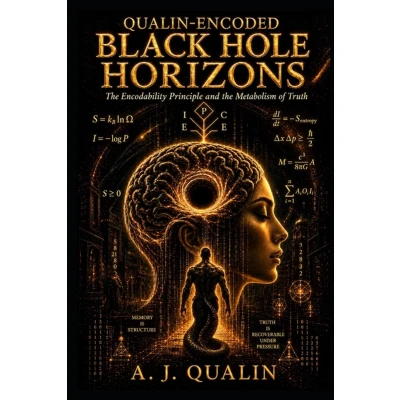
What if the universe could preserve everything except what mattered?The universe is 13.8 billion years old. Its oldest visible light was released when the cosmos was only about 380,000 years old, and tiny variations in that radiation, roughly one part in 100,000, became the seeds of galaxies, stars, planets, life, and memory. At the opposite frontier stands the black hole, the boundary where even light loses the ordinary path of return. M87, the first black hole ever imaged, weighs about 6.5 billion Suns and lies 55 million light years away.Qualin-Encoded Black Hole Horizons begins at that frontier, with a human being approaching the horizon. From outside, physics may still preserve mass, spin, charge, entropy, radiation, and correlation. From inside, a life is still happening: fear, perception, memory, the last image of a face, and the final pressure of being alive. If the universe keeps the data but loses the witness, has anything essential been saved?This book is a philosophical investigation shaped by physics, artificial intelligence, neuroscience, and the age of total archives. Its central claim is severe: information is not memory, memory is not truth, and truth is not recovery. At its core stands the Encodability Principle: meaning is not secured by storage alone. To matter, it must cross an interface, remain portable, survive independent reconstruction, and arrive before its window closes. An explanation that comes too late becomes evidence, not rescue. A signal that cannot be recovered becomes silence with metadata.From cosmic microwave background radiation to event horizons, from AI systems trained on planetary memory to the roughly 86 billion neurons of the human brain, the same question returns at every scale: what can pass without becoming false? This is not a theory of new physics. It uses physics as the hardest arena for a deeper problem: the difference between preservation and recovery. Black holes test what can escape. AI tests whether stored language can become understanding. The brain tests whether signals can become experience. Civilization tests whether archives can protect the dead from being misunderstood.For readers drawn to physics, consciousness, artificial intelligence, metaphysics, memory, and the philosophy of information, Qualin-Encoded Black Hole Horizons asks one question with cosmic and human consequences: when everything can be stored, what can still return as truth?A trace is not a resurrection. A record is not a life. Preservation is not salvation.
 Prijshistorie
 * Prijshistorie bevat geen data van Amazon, Amazon Marketplace.
Prijzen voor het laatst bijgewerkt op:
 Gerelateerde resultaten
 Productspecificaties


