


€ 145,00 Gratis verzending

Uitgelicht
|
|
145,00 |
Naar shop
|

|
159,99 |
Naar shop
|

|
159,99 |
Naar shop
|
| VERGELIJK ALLE AANBIEDERS (3) | ||
 Beschrijving
Vergelijk aanbieders (3)
€ 145,00 Gratis verzending
€ 159,99 Gratis verzending
€ 159,99 Gratis verzending
Winkels met andere maten
Beschrijving
(1)
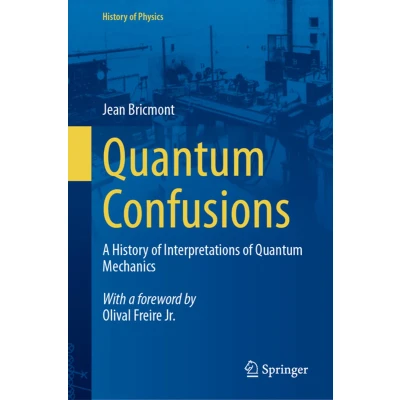
One of history’s greatest mathematicians, John von Neumann, claimed to have a rigorous proof that quantum mechanics was “complete”, and many physicists took his result for granted, although he did not prove what he believed to have proven. This book does not simply tell a story about the development of quantum mechanics, but clarifies our ideas about its meaning by discussing the many misunderstandings that one finds in the scientific literature. For instance, Erwin Schrödinger never thought that his cat was both dead and alive; that example was meant to be a reductio ad absurdum of the quantum orthodoxy. Most people believe that Bohr won his many debates with Einstein, but this book argues that Bohr never really understood Einstein’s objections. Louis de Broglie’s ideas about pilot waves were summarily dismissed at the 1927 Solvay Conference, which led him to abandon his own theory; he was, however, ahead of his time in some ways. One of history’s greatest mathematicians, John von Neumann, claimed to have a rigorous proof that quantum mechanics was “complete”, and many physicists took his result for granted, although he did not prove what he believed to have proven. In 1952, David Bohm rediscovered de Broglie's theory and extended it, but he was ignored due to reasons both ideological and political. John Bell actually proved that the world is nonlocal, but even now his work remains widely misunderstood. The target audience for this non-technical book includes undergraduate students (and above) in physics, mathematics, or history and philosophy of science, and even interested lay readers.
 Prijshistorie
 * Prijshistorie bevat geen data van Amazon, Amazon Marketplace.
Prijzen voor het laatst bijgewerkt op:
 Gerelateerde resultaten
 Productspecificaties


