
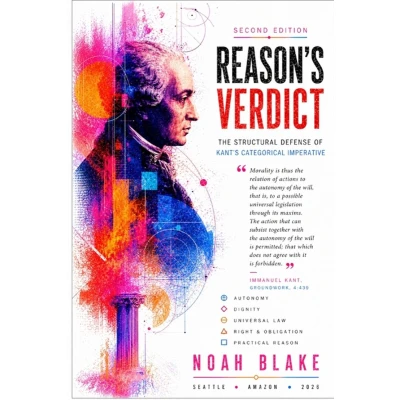
REASON’S VERDICT: The Structural Defense of Kant’s Categorical Imperative
Uitgelicht

|
13,00 |
Naar shop
|

|
13,77 |
Naar shop
|

|
13,77 |
Naar shop
|
| VERGELIJK ALLE AANBIEDERS (3) | ||
 Beschrijving
Bol
What gives a moral obligation its authority? Not nature, not society, not divine command-but reason itself. This is Kant's most ambitious claim, and it has never been more contested than now. For more than two centuries, the categorical imperative has been admired, attacked, and pronounced obsolete. In the last decade alone, a new generation of philosophers has reopened every foundational question: Is the moral law self-legislated or a priori? What grounds human dignity? Can a purely formal principle yield real duties? Is Kant's ethics an empty formalism, a blind rigorism, a morality that asks too much? Reason's Verdict answers these challenges not by retreating to old certainties but by mounting a structural defense. Its central claim is that autonomy, dignity, the universality of law, and the order of right are not separate doctrines but a single, interlocking architecture of practical reason-each intelligible only through the others. Dislodge one and the rest lose their footing; hold them together and the structure carries the full weight that rights, equality, and obligation place upon it. Across seven chapters, the book takes each major front of the contemporary debate, states the strongest recent objection in its most demanding form, and shows that the structural reading absorbs it without deforming Kant's commitments. Engaging rigorously with the peer-reviewed scholarship of 2021-2026-and citing only real, verifiable sources-it offers the specialist a reading built to withstand the latest literature, and the serious reader a case for why Kant's answer to the problem of obligation remains the one to beat. Where a dispute is genuinely open, the book says so. Where the critics score a point, it concedes it. And it argues, in the end, that the deepest objections strike only at misreadings of Kant-and that reason's verdict on the moral law still stands. A demanding, original, and unfashionably confident work of moral philosophy for readers of Kant, Korsgaard, O'Neill, and Wood.


 Beschrijving
(1)
Beschrijving
(1)
What gives a moral obligation its authority? Not nature, not society, not divine command-but reason itself. This is Kant's most ambitious claim, and it has never been more contested than now. For more than two centuries, the categorical imperative has been admired, attacked, and pronounced obsolete. In the last decade alone, a new generation of philosophers has reopened every foundational question: Is the moral law self-legislated or a priori? What grounds human dignity? Can a purely formal principle yield real duties? Is Kant's ethics an empty formalism, a blind rigorism, a morality that asks too much? Reason's Verdict answers these challenges not by retreating to old certainties but by mounting a structural defense. Its central claim is that autonomy, dignity, the universality of law, and the order of right are not separate doctrines but a single, interlocking architecture of practical reason-each intelligible only through the others. Dislodge one and the rest lose their footing; hold them together and the structure carries the full weight that rights, equality, and obligation place upon it. Across seven chapters, the book takes each major front of the contemporary debate, states the strongest recent objection in its most demanding form, and shows that the structural reading absorbs it without deforming Kant's commitments. Engaging rigorously with the peer-reviewed scholarship of 2021-2026-and citing only real, verifiable sources-it offers the specialist a reading built to withstand the latest literature, and the serious reader a case for why Kant's answer to the problem of obligation remains the one to beat. Where a dispute is genuinely open, the book says so. Where the critics score a point, it concedes it. And it argues, in the end, that the deepest objections strike only at misreadings of Kant-and that reason's verdict on the moral law still stands. A demanding, original, and unfashionably confident work of moral philosophy for readers of Kant, Korsgaard, O'Neill, and Wood.
 Productspecificaties
 Prijshistorie
* Prijshistorie bevat geen data van Amazon, Amazon Marketplace.
Prijzen voor het laatst bijgewerkt op:
 Gerelateerde resultaten


