
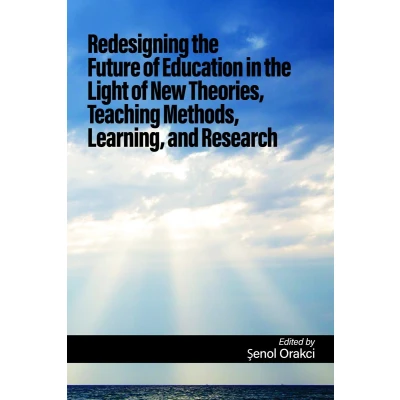
Redesigning the Future of Education in Light New Theories, Teaching Methods, Learning, and Research
Uitgelicht

|
51,99 |
Naar shop
|
| VERGELIJK ALLE AANBIEDERS (1) | ||
 Beschrijving
Bol
This book explores learning beyond physical boundaries, emphasizing 21st-century skills like creativity, problem-solving, and social-emotional skills. It advocates for lifelong learning and integrating real-life experiences into education. Contributions from seven continents offer diverse insights for future education. Learning used to be confined to a physical place. Now, it’s no longer limited by walls or daylight or location. Learning happens in spaces that transcend these boundaries. These spaces can still have physical elements, but they are no longer defined by a physical footprint and constrained by the limitations of time, space, and matter. Learning can now take place on any device, in any place, and at any time. 21st century skills are one of the concepts we use most frequently when talking about innovative education. We see that the skills, referred to as 21st century skills, include cognitive skills such as creative thinking, problem solving, as well as many different social and emotional skills such as understanding, expressing, empathy and teamwork. Many educators now agree that not only academic knowledge is sufficient, but social-emotional skills play a role as much as academic knowledge in a person's success and happiness. Another accepted fact is the phenomenon of lifelong learning: the fact that education does not start at school but does not end at school, in fact, it is a process that should continue throughout life. While accepting all this, a subject that is not discussed much; how this holistic, lifelong learning is possible in a class in the form of 40 minutes lessons and 10 minutes of break. While we are designing various kinds of education programs for children to gain all these different skill sets in the classroom, do not we actually keep these skills in the easiest way, practically away from the environments they will acquire? In John Dewey's book, “Experience and Education” (1938), information obtained as detached from real life is depicted as wasted time and effort. Most teachers are already aware of this situation. For this reason, they try to explain math problems and literacy by linking them to children's experiences and lives as much as possible, and they do many big and small experiments in social sciences and science lessons. Can't we go one step further than this? Can't we make learning in life a part of our education system, instead of preparing small examples of real life for children? With many justified concerns such as assessment, security, teachers' pedagogical infrastructure, we miss out on the most important opportunities for education just because they are outside the walls of the school? This book aims to open new horizons in the journey of learning beyond the school walls in the world and contribute to the spread of learning in our society. In societies where constant change is the norm, schools today must prepare students to be successful in environments and contexts that may differ greatly from what we experience today. But, are we really thinking about the future? With contributions from seven continents, this book will reveal a ‘snapshot’ of some of our best thinking for building new education futures. Diverse experiences, visions, and ideas are shared to help spark new thinking among educators and policymakers, provoke conversation, and facilitate new ideas for meeting human development needs in a rapidly transforming world.


Vergelijk aanbieders (1)

 Beschrijving
(1)
Beschrijving
(1)
This book explores learning beyond physical boundaries, emphasizing 21st-century skills like creativity, problem-solving, and social-emotional skills. It advocates for lifelong learning and integrating real-life experiences into education. Contributions from seven continents offer diverse insights for future education. Learning used to be confined to a physical place. Now, it’s no longer limited by walls or daylight or location. Learning happens in spaces that transcend these boundaries. These spaces can still have physical elements, but they are no longer defined by a physical footprint and constrained by the limitations of time, space, and matter. Learning can now take place on any device, in any place, and at any time. 21st century skills are one of the concepts we use most frequently when talking about innovative education. We see that the skills, referred to as 21st century skills, include cognitive skills such as creative thinking, problem solving, as well as many different social and emotional skills such as understanding, expressing, empathy and teamwork. Many educators now agree that not only academic knowledge is sufficient, but social-emotional skills play a role as much as academic knowledge in a person's success and happiness. Another accepted fact is the phenomenon of lifelong learning: the fact that education does not start at school but does not end at school, in fact, it is a process that should continue throughout life. While accepting all this, a subject that is not discussed much; how this holistic, lifelong learning is possible in a class in the form of 40 minutes lessons and 10 minutes of break. While we are designing various kinds of education programs for children to gain all these different skill sets in the classroom, do not we actually keep these skills in the easiest way, practically away from the environments they will acquire? In John Dewey's book, “Experience and Education” (1938), information obtained as detached from real life is depicted as wasted time and effort. Most teachers are already aware of this situation. For this reason, they try to explain math problems and literacy by linking them to children's experiences and lives as much as possible, and they do many big and small experiments in social sciences and science lessons. Can't we go one step further than this? Can't we make learning in life a part of our education system, instead of preparing small examples of real life for children? With many justified concerns such as assessment, security, teachers' pedagogical infrastructure, we miss out on the most important opportunities for education just because they are outside the walls of the school? This book aims to open new horizons in the journey of learning beyond the school walls in the world and contribute to the spread of learning in our society. In societies where constant change is the norm, schools today must prepare students to be successful in environments and contexts that may differ greatly from what we experience today. But, are we really thinking about the future? With contributions from seven continents, this book will reveal a ‘snapshot’ of some of our best thinking for building new education futures. Diverse experiences, visions, and ideas are shared to help spark new thinking among educators and policymakers, provoke conversation, and facilitate new ideas for meeting human development needs in a rapidly transforming world.
 Productspecificaties
| EAN |
|
|---|---|
| Maat |
|
 Prijshistorie
Prijzen voor het laatst bijgewerkt op:
 Gerelateerde resultaten


