
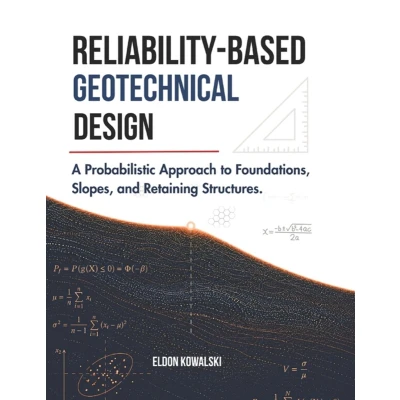
Reliability-Based Geotechnical Design: A Probabilistic Approach to Foundations, Slopes, and Retaining Structures.
Uitgelicht

|
76,99 |
Naar shop
|

|
84,26 |
Naar shop
|

|
84,26 |
Naar shop
|
| VERGELIJK ALLE AANBIEDERS (3) | ||
 Beschrijving
Bol
For most of the twentieth century, a single number - the factor of safety - carried the entire weight of uncertainty in geotechnical design. Modern codes ask for something more: not a promise that a design is safe, but evidence of how safe, expressed in the language of probability. Load and resistance factor design and partial-factor methods are now the working framework for foundation, slope, and retaining-wall practice. Yet many engineers were trained only in deterministic factors of safety, leaving a real gap between the way geotechnical safety is taught and the way current codes require it to be calibrated, documented, and defended. Soil variability, model error, and the consequences of failure can no longer be absorbed by tradition alone. This book was written to close that gap. It develops the probabilistic machinery of reliability-based design from first principles, with every derivation shown, and then carries that theory directly into the foundations, walls, and slopes engineers design in practice - connecting reliability indices to the resistance factors, load factors, and target reliability values published in the codes. What you will gain: - Trace geotechnical uncertainty to its sources and separate soil variability, measurement error, and model bias.- Follow each method with its derivation shown in full, then a worked example carried to a clear final answer.- Formulate limit-state functions for bearing capacity, settlement, sliding, and slope failure from realistic data.- Calculate reliability by first- and second-order methods and by Monte Carlo simulation, including rare-event techniques.- Apply calibrated resistance factors and compare the result with a partial-factor design check on the same problem.- Extend beyond single limit states into system reliability, Bayesian updating, and risk-based decision analysis.- Reinforce every chapter with practice problems and complete answer keys. Key topics include uncertainty and risk; probability and statistics for engineers; soil variability and random fields; first- and second-order reliability methods; Monte Carlo, importance sampling, and subset simulation; code calibration and resistance-factor derivation; partial-factor design and characteristic values; shallow and deep foundations; retaining structures; slope stability; system reliability; Bayesian updating; risk and decision analysis; and complete worked case studies. It is written for graduate students encountering reliability theory for the first time and for practicing geotechnical, civil, and bridge engineers moving from deterministic design to code-calibrated reliability-based methods - readers who want both to learn the theory and to keep a dependable, example-driven reference at hand. Take the next step from deterministic habit to reliability-based practice, and build the probabilistic foundation - from first principles to applied design - that modern geotechnical codes now expect.


 Beschrijving
(1)
Beschrijving
(1)
For most of the twentieth century, a single number - the factor of safety - carried the entire weight of uncertainty in geotechnical design. Modern codes ask for something more: not a promise that a design is safe, but evidence of how safe, expressed in the language of probability. Load and resistance factor design and partial-factor methods are now the working framework for foundation, slope, and retaining-wall practice. Yet many engineers were trained only in deterministic factors of safety, leaving a real gap between the way geotechnical safety is taught and the way current codes require it to be calibrated, documented, and defended. Soil variability, model error, and the consequences of failure can no longer be absorbed by tradition alone. This book was written to close that gap. It develops the probabilistic machinery of reliability-based design from first principles, with every derivation shown, and then carries that theory directly into the foundations, walls, and slopes engineers design in practice - connecting reliability indices to the resistance factors, load factors, and target reliability values published in the codes. What you will gain: - Trace geotechnical uncertainty to its sources and separate soil variability, measurement error, and model bias.- Follow each method with its derivation shown in full, then a worked example carried to a clear final answer.- Formulate limit-state functions for bearing capacity, settlement, sliding, and slope failure from realistic data.- Calculate reliability by first- and second-order methods and by Monte Carlo simulation, including rare-event techniques.- Apply calibrated resistance factors and compare the result with a partial-factor design check on the same problem.- Extend beyond single limit states into system reliability, Bayesian updating, and risk-based decision analysis.- Reinforce every chapter with practice problems and complete answer keys. Key topics include uncertainty and risk; probability and statistics for engineers; soil variability and random fields; first- and second-order reliability methods; Monte Carlo, importance sampling, and subset simulation; code calibration and resistance-factor derivation; partial-factor design and characteristic values; shallow and deep foundations; retaining structures; slope stability; system reliability; Bayesian updating; risk and decision analysis; and complete worked case studies. It is written for graduate students encountering reliability theory for the first time and for practicing geotechnical, civil, and bridge engineers moving from deterministic design to code-calibrated reliability-based methods - readers who want both to learn the theory and to keep a dependable, example-driven reference at hand. Take the next step from deterministic habit to reliability-based practice, and build the probabilistic foundation - from first principles to applied design - that modern geotechnical codes now expect.
 Productspecificaties
 Prijshistorie
* Prijshistorie bevat geen data van Amazon, Amazon Marketplace.
Prijzen voor het laatst bijgewerkt op:
 Gerelateerde resultaten


