
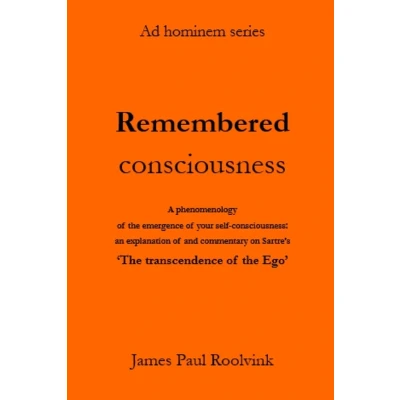
Remembered consciousness: A phenomenology of the emergence your self-consciousness: an explanation and commentary on Sartre’s ‘The transcendence Ego’
Uitgelicht

|
23,41 |
Naar shop
|

|
23,41 |
Naar shop
|

|
23,50 |
Naar shop
|
| VERGELIJK ALLE AANBIEDERS (3) | ||
 Beschrijving
Bol
This is a major work in the field of the 'philosophy of mind', but there is great confusion-and hence disagreement-about what the 'mind' actually is. In our current zeitgeist, the 'mind' is equated with the brain (and or stomach). Unravelling what the 'mind' is will resolve all the Babylonian confusion of language in continental and Anglo-Saxon philosophy, for whatever enigma may be at issue (time, God, colour, sexuality, etc.), that enigma always exists for the 'mind'. This work demonstrates how Sartre can enrich Anglo-Saxon philosophy through a discussion of Nagel's 1974 article 'What is it like to be a bat?'. It will also meticulously demonstrate the relationship between Sartres description of the mind with Indian philosophy regarding what the 'mind' is. This work will, in the wake of a word-for-word explanation of and critical commentary on Sartre's 1934 essay 'The Transcendence of the Ego', by listening to the distinctions between, amongst others, the individual, the self, the personal, the mind, consciousness, the Ego, the 'Me', the 'I', time, sensation, emotional state, mood, pain and pleasure, soul, life, energy, self-awareness, etc. Words such as 'I', 'self', 'me', 'soul' and 'personality' are usually lumped together as synonyms, but when it becomes clear that they have different meanings and also arise in a different sequence over time, a completely different ontology will suddenly unfold, one in which there is also room for different kinds of 'minds', such as those of plants, stones, angels, etc.. This is an indispensable book for anyone who wishes to escape the current zeitgeist and understand both the present spirit of the age and its history. It is written with an almost frightening clarity and is therefore particularly suitable for lay readers. This book will also be of practical use to psychoanalysts and psychologists. Furthermore, the book sets out the justification for a political philosophy that can serve as a principle for political 'engagement' (11 April 2023), in which no one owns themselves, as in moral libertarianism, nor does anyone own others; the state, which does not exist, is not an owner either, as in communism; and where a true communal brotherhood can prevail, as in a genuine theocracy. (26 July 2023). This book and the text above have been translated by the translation machine DeepL from Dutch into English.


 Beschrijving
(1)
Beschrijving
(1)
This is a major work in the field of the 'philosophy of mind', but there is great confusion-and hence disagreement-about what the 'mind' actually is. In our current zeitgeist, the 'mind' is equated with the brain (and or stomach). Unravelling what the 'mind' is will resolve all the Babylonian confusion of language in continental and Anglo-Saxon philosophy, for whatever enigma may be at issue (time, God, colour, sexuality, etc.), that enigma always exists for the 'mind'. This work demonstrates how Sartre can enrich Anglo-Saxon philosophy through a discussion of Nagel's 1974 article 'What is it like to be a bat?'. It will also meticulously demonstrate the relationship between Sartres description of the mind with Indian philosophy regarding what the 'mind' is. This work will, in the wake of a word-for-word explanation of and critical commentary on Sartre's 1934 essay 'The Transcendence of the Ego', by listening to the distinctions between, amongst others, the individual, the self, the personal, the mind, consciousness, the Ego, the 'Me', the 'I', time, sensation, emotional state, mood, pain and pleasure, soul, life, energy, self-awareness, etc. Words such as 'I', 'self', 'me', 'soul' and 'personality' are usually lumped together as synonyms, but when it becomes clear that they have different meanings and also arise in a different sequence over time, a completely different ontology will suddenly unfold, one in which there is also room for different kinds of 'minds', such as those of plants, stones, angels, etc.. This is an indispensable book for anyone who wishes to escape the current zeitgeist and understand both the present spirit of the age and its history. It is written with an almost frightening clarity and is therefore particularly suitable for lay readers. This book will also be of practical use to psychoanalysts and psychologists. Furthermore, the book sets out the justification for a political philosophy that can serve as a principle for political 'engagement' (11 April 2023), in which no one owns themselves, as in moral libertarianism, nor does anyone own others; the state, which does not exist, is not an owner either, as in communism; and where a true communal brotherhood can prevail, as in a genuine theocracy. (26 July 2023). This book and the text above have been translated by the translation machine DeepL from Dutch into English.
 Productspecificaties
 Prijshistorie
* Prijshistorie bevat geen data van Amazon, Amazon Marketplace.
Prijzen voor het laatst bijgewerkt op:
 Gerelateerde resultaten


